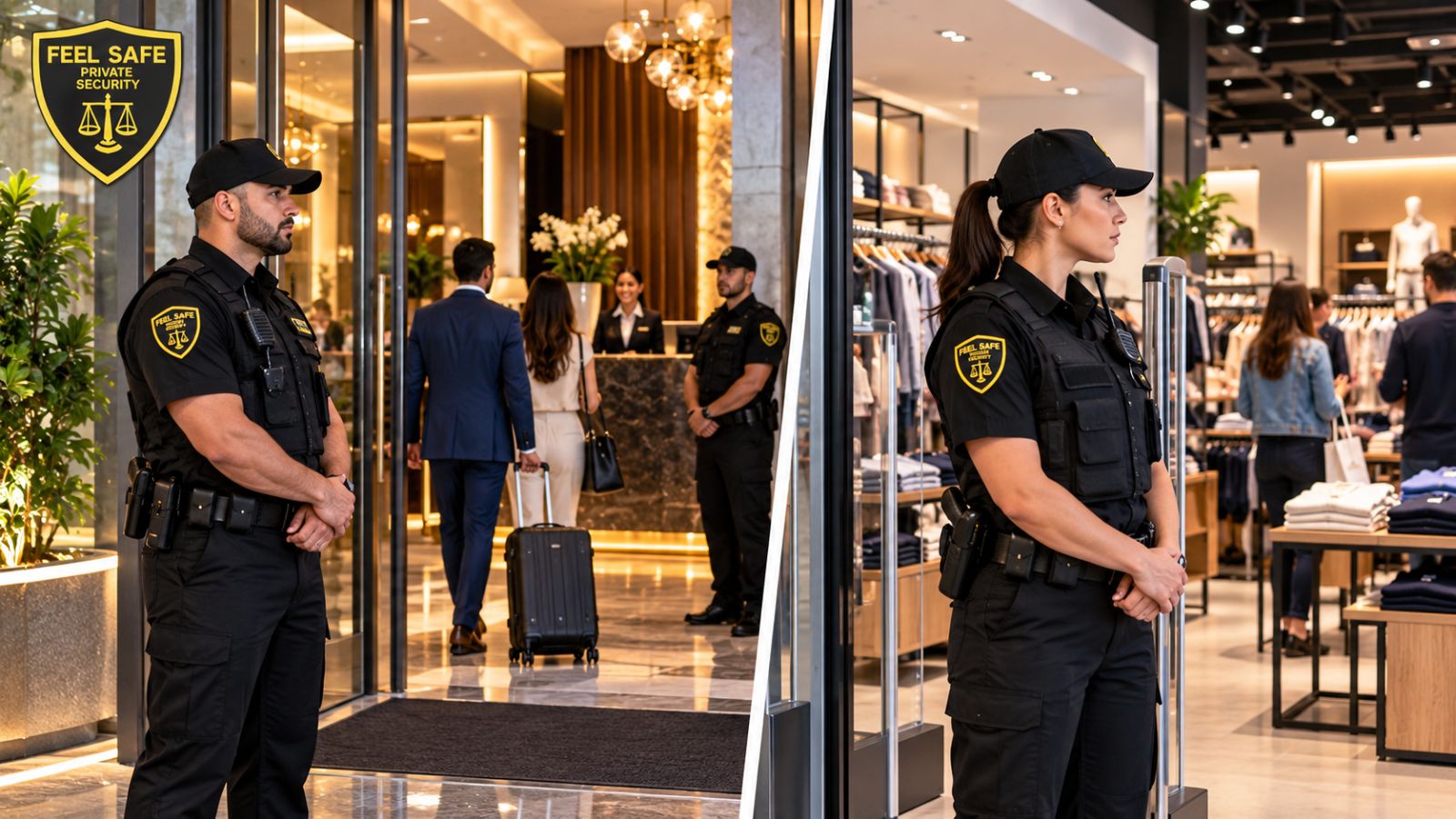
Security Solutions for Hotels and Retail Stores
Post Date: September 23, 2026, Post By: Admin
Hotels and retail stores face very different security challenges, but they share one important requirement: people need to feel safe while the property remains welcoming and operational. A hotel may need to manage guest access, parking areas, overnight activity, and emergencies, while a retail store may be more concerned with theft, customer incidents, employee safety, and suspicious activity. Well-planned Security Solutions bring these needs together through trained personnel, clear procedures, visible deterrence, and consistent reporting.
For businesses considering hotel and retail security guards in California, the key is not simply deciding how many guards to place on-site. The more useful question is what the property needs the security team to accomplish, when risks are highest, and how guards should work alongside managers, employees, customers, guests, and emergency responders.
Why Hotels and Retail Stores Need Different Security Strategies
Security planning should begin with the property rather than with a generic list of guard duties. A hotel operates continuously and may have guests arriving at all hours, employees working overnight, contractors entering restricted areas, and vehicles moving through parking facilities. may have different visibility and access-control challenges because rooms and parking areas can be more exposed to public areas.
Retail properties operate differently. Customer traffic can change dramatically throughout the day, particularly during weekends, holidays, sales events, or seasonal periods. Employees may also need assistance with disruptive behavior, suspicious activity, or emergencies without creating an uncomfortable atmosphere for legitimate shoppers.
This is why hotel security services California businesses use should be developed around actual operating conditions. Similarly, retail store security guards California businesses employ should understand the layout, merchandise risks, customer flow, employee procedures, and incident-reporting expectations of the particular store.
A practical assessment should examine:
- Main entrances and exits
- Parking and loading areas
- Employee-only spaces
- Cameras and alarm systems
- Guest or customer traffic patterns
- Lighting conditions
- Blind spots
- High-value assets
- Previous incidents
- Opening and closing procedures
- Emergency exits and evacuation routes
The objective is not to make a property look heavily guarded. It is to create a security presence that addresses identifiable risks while allowing normal business activity to continue.
Hotel Security: Protecting Guests Without Creating an Unwelcoming Environment
Hotels require a particularly balanced approach because security personnel interact with people who are staying on the property rather than simply visiting for a short transaction. Guests expect privacy, convenience, and hospitality. At the same time, management has to consider unauthorized access, disturbances, theft, medical incidents, property damage, and other situations that can affect guests and employees.
Guest Safety Security Starts With Hotel Entrance Monitoring
The main entrance is often one of the most important points for guest safety security. Guards may monitor who enters the property, observe unusual behavior, assist with incidents, and communicate concerns to hotel management. The precise responsibilities depend on the hotel’s policies and the security assignment.
Hotel entrance monitoring should not necessarily mean stopping every person who enters the building. In many properties, a better approach is maintaining situational awareness while identifying activity that requires attention. A professional guard can provide a visible presence while allowing ordinary guests, employees, delivery drivers, and authorized visitors to move through the property efficiently.
For example, imagine a hotel with a busy lobby late at night. A guard notices an individual repeatedly entering and leaving without an apparent reason. Rather than immediately escalating the situation, the guard can observe the behavior, communicate with the appropriate manager, and follow the property’s established procedures. That measured approach can prevent unnecessary confrontation while still addressing a potential concern.
Parking Areas Need Their Own Security Considerations
Hotel parking areas are often overlooked when businesses design security plans. Yet they can be physically separated from the main lobby and may have lower visibility, particularly at night. Guards may conduct scheduled patrols, observe unusual activity, assist guests who report concerns, and communicate incidents to management.
Patrols should be structured rather than random whenever possible. The security team should understand which areas require more frequent attention, where lighting is limited, and where emergency access needs to remain unobstructed. Parking security should also complement cameras and lighting rather than attempting to replace them.
Overnight Hotel Security Requires Clear Handover Procedures
Overnight operations create a different working environment. There may be fewer managers and employees available, while the property remains occupied. A guard may therefore need clear instructions regarding emergencies, guest complaints, access to restricted areas, and communication with management.
A written post order can make a significant difference. California’s Bureau of Security and Investigative Services (BSIS) specifically identifies site-specific assignments, equipment, monitoring, communication, emergency response, alarms, liability considerations, and post orders as areas relevant to security guard training.
The practical lesson for hotel managers is straightforward: guards should know what is expected before an incident occurs.
Hotel Security Guards California: Addressing Property Access and Visibility
Hotel environments can present different security requirements from larger hotels. Individual rooms may have exterior-facing doors, parking can be located immediately beside guest rooms, and property boundaries may be more accessible from public roads or adjacent areas.
Hotel security guards California operators hire should therefore understand the specific property layout and the relationship between guest areas, parking spaces, office facilities, service areas, and public access points.
A useful security plan may include scheduled patrols, entrance observation, parking-area checks, incident reporting, and communication with front-desk personnel. Guards should also know which situations require immediate management involvement and which should be documented for later review.
The goal is not to assume that every unfamiliar person represents a threat. Instead, guards should identify behavior that is inconsistent with normal property activity and respond according to established procedures.
Retail Security: Combining Loss Prevention With Customer Safety
Retail environments require a different balance. A guard may spend part of a shift monitoring entrances and exits, observing customer activity, assisting employees, and responding to incidents. At the same time, excessive or poorly handled security activity can make customers uncomfortable.
Effective retail security therefore combines visibility with professional judgment.
Retail Property Protection Is More Than Theft Prevention
Retail property protection is sometimes treated as a synonym for shoplifting prevention, but the responsibility can be broader. Security personnel may help protect customers, employees, merchandise, equipment, entrances, and the physical premises.
For instance, consider a store where employees notice repeated suspicious activity near a high-value product section. A useful security response may involve increased observation, communication with store management, reviewing available surveillance footage, and documenting relevant incidents. The response should be consistent with the store’s policies and applicable law.
Store Security Should Support Employees
Employees often notice problems before anyone else does. A security plan should give them a clear way to communicate concerns without expecting them to personally manage situations outside their role.
For example, a retail employee who sees a developing dispute should know whom to contact and what information to provide. The guard should then have a defined process for assessing the situation and determining the appropriate response.
Store security works better when employees and security personnel understand each other’s responsibilities. Guards should not become informal store managers, while employees should not be expected to perform security duties for which they have not been trained.
Hospitality Security: Creating a Consistent Response System
Hotels are part of the broader hospitality industry, where security must coexist with customer service. Hospitality security is therefore not simply about preventing incidents. It is also about responding professionally when something does happen.
Hospitality Security Services Need Clear Communication
A guard may identify a concern, but the quality of the outcome often depends on what happens next. Who receives the information? Who contacts management? When should emergency services be contacted? Who records the incident? What information should be preserved?
These questions should be answered before a serious incident occurs.
A communication structure might involve:
Guard identifies or receives information about an incident.
Guard assesses the situation within the scope of the assignment.
Supervisor or designated manager is informed.
Emergency services are contacted when appropriate.
Relevant details are documented.
Management reviews the incident and determines whether procedures need to change.
The exact process should reflect the property’s policies and circumstances. The important point is that security should operate as part of the property’s wider management system.
Choosing Hotel and Retail Security Guards in California
When evaluating hotel and retail security guards in California, property managers should look beyond appearance and hourly pricing. A security team needs to be appropriately registered, trained, supervised, and prepared for the environment in which it will work.
California BSIS states that security guard applicants must be at least 18, undergo a criminal-history background check through the California Department of Justice and FBI, and complete required training. The Bureau also requires initial security officer skills training and continuing training.
For businesses, this means basic due diligence should include asking about:
- BSIS registration and verification
- Required training
- Site-specific orientation
- Post orders
- Supervisor availability
- Incident-reporting procedures
- Emergency communication
- Patrol expectations
- Scheduling and relief coverage
- Management communication
- Insurance and contractual responsibilities
BSIS also provides an online license-verification service, allowing businesses to verify relevant registrations rather than relying solely on verbal assurances.
What Effective Security Staffing Looks Like in Practice
There is no universal guard-to-property ratio that automatically produces effective security. A small retail store with limited operating hours has different requirements from a large shopping environment. Likewise, a roadside a full-service hotel may need different coverage.
Staffing should consider:
- Property size
- Number of entrances
- Operating hours
- Guest or customer volume
- Parking arrangements
- Location-specific risks
- Special events
- Previous incidents
- Employee numbers
- High-risk operating periods
For example, a hotel may require more visible coverage during late-night hours and busy check-in periods, while a retail store may need additional personnel during major sales or holiday shopping periods.
This is where Security Solutions should be treated as a planning concept rather than a package of identical services. Good security adapts to the property’s actual operating environment.
Technology Should Support Guards, Not Replace Them
Cameras, access-control systems, alarms, radios, lighting, and other technology can strengthen a security program. However, technology is most useful when someone has clearly defined responsibility for responding to what it detects.
A camera may show activity in a parking area, but a trained professional still has to assess what is happening and follow the appropriate procedure. An access-control system may restrict a staff entrance, but management still needs a process for lost credentials or unauthorized access attempts.
The strongest approach is usually a combination of physical security, technology, documented procedures, trained employees, and management oversight.
Common Security Mistakes Hotels and Retailers Should Avoid
One common mistake is hiring security without first defining the assignment. A guard who does not know which areas to patrol, whom to contact, or what management expects may spend an entire shift present without addressing the property’s most important risks.
Another mistake is focusing exclusively on visible deterrence. A uniformed guard at an entrance can be valuable, but security also depends on communication, reporting, patrols, employee awareness, lighting, cameras, access controls, and emergency planning.
Businesses should also avoid treating every incident in exactly the same way. A customer complaint, suspected theft, medical emergency, aggressive behavior, unauthorized access attempt, and fire alarm can require very different responses.
Finally, documentation should not be overlooked. Accurate incident reports can help management identify recurring patterns and determine whether staffing or procedures should be adjusted.
Expert Tips for Better Hotel and Retail Security Planning
1. Walk the Property During Real Operating Hours
A daytime inspection may reveal very little about nighttime conditions. Walk the property during different shifts and observe lighting, customer flow, parking activity, employee movement, and access points.
2. Build Post Orders Around the Actual Site
Generic instructions are rarely enough. Guards should understand the property’s entrances, restricted areas, equipment, communication channels, emergency procedures, and specific responsibilities. BSIS training guidance specifically includes site-specific assignments and post orders as part of security officer training.
3. Review Incidents for Patterns
Do not treat incident reports as paperwork that gets filed and forgotten. Review them periodically. Repeated issues at the same entrance, during the same hours, or around the same type of activity may indicate a need to change procedures.
4. Keep Management Involved
Security is more effective when managers know what guards are seeing. Regular communication can identify changing conditions, staffing gaps, maintenance problems, and recurring guest or customer concerns.
5. Train for the Environment
California requires registered security guards to complete specified training, including initial skills training and continuing education. BSIS training covers areas including appropriate use of force, legal considerations, the role of a security guard, post orders, emergency response, and communication.
A property should also provide site-specific orientation so guards understand how those general skills apply to the actual assignment.
When to Review Your Security Plan
A security plan should not be considered a document that is written once and left unchanged. Review it when the property changes ownership, adds entrances, changes operating hours, introduces new technology, experiences recurring incidents, expands its parking area, hosts major events, or changes its customer or guest profile.
A quarterly or periodic management review can also be useful even when nothing obvious has changed. Conditions around a property can change independently of the business itself, and security procedures should be adjusted when the risk environment changes.
Conclusion:
Effective Security Solutions for hotels, and retail stores begin with understanding how each property actually operates. Hotel security services California businesses require may center on guest safety, entrance monitoring, parking, and overnight response, while retail store security guards California assignments may place greater emphasis on retail property protection, employee support, suspicious activity, and merchandise security.
For businesses considering hotel and retail security guards in California, the most important step is to create a clear, property-specific plan. That means defining guard responsibilities, verifying appropriate registration and training, establishing communication procedures, reviewing incidents, and combining trained personnel with technology and sound management practices. The aim is not simply to have a security guard on-site. It is to build a practical security system that supports people, protects property, and fits naturally into everyday operations.
Feel Safe Private Security can be considered by businesses that need assistance evaluating security requirements across hospitality or retail environments. A useful initial discussion should focus on the property’s layout, operating hours, staffing needs, recurring concerns, and the specific responsibilities expected from the security team.
For a property developing or reviewing its security program, Feel Safe Private Security can also help translate those operational requirements into practical security procedures and guard assignments. Feel Safe Private Security can work with management to consider coverage, patrols, access control, incident reporting, and other elements that contribute to a structured security approach without turning the property into an unnecessarily restrictive environment.
FAQs
1. What should a hotel security plan include?
A hotel security plan should address access control, lobby and entrance monitoring, parking areas, employee-only spaces, patrols, emergency communication, incident reporting, guest concerns, restricted areas, and procedures for escalating serious incidents. The plan should be customized to the hotel’s physical layout and operating schedule. Security personnel should also receive site-specific instructions rather than relying only on general security training.
2. What is the difference between hotel security and retail security?
Hotel security focuses heavily on guest safety, access control, property monitoring, overnight operations, parking, and hospitality-related incidents. Retail security commonly emphasizes merchandise protection, customer and employee safety, access points, suspicious activity, and loss-prevention support. The two environments overlap, but the guard’s post orders and priorities should reflect the property’s specific risks and operating model.
3. Are security guards in California required to be registered?
For standard private security guard work covered by BSIS requirements, guards must obtain the appropriate BSIS Security Guard Registration. California requires applicants to meet eligibility requirements, undergo a DOJ and FBI background check, and complete required training. Registered guards also have continuing training obligations. Businesses should verify current registration and applicable requirements through BSIS rather than relying on an individual’s claims.
4. Should hotels and stores use security cameras as well as guards?
Cameras and guards perform different functions and can complement one another. Cameras provide monitoring and recorded information, while trained security personnel can observe conditions, communicate with management, respond according to established procedures, and provide a visible presence. The most useful combination depends on the property’s layout, staffing, technology, operating hours, and identified risks.
5. How often should a hotel or retail security plan be reviewed?
There is no single review interval that fits every property. A plan should be reviewed after significant incidents and whenever there are substantial changes to the property, operating hours, entrances, staffing, technology, or expected customer or guest volume. Periodic management reviews are also useful for identifying recurring incidents and checking whether existing procedures still match the property’s current needs.
Book Your Services
Our Blog
- Security Solutions for Hotels and Retail Stores
- What to Expect From Rapid Response Security Services in California
- How Rapid Response Security Teams Handle Emergencies
- Security Challenges in Parking Lots and Retail Centers
- Why Shopping Centers Need Professional Security Guards
- How Fast Should a Security Team Respond? A Guide to Rapid Response Security Services in California
- Event Security Planning Guide for Safe Gatherings
- Benefits of Residential Security Guards for Community Safety
- How to Choose the Best Security Guard Company in California
- Why 24 Hour Security Monitoring Is Important for Businesses
- Why Hospitals and Clinics Need Professional Security Services
- Why Apartment Complexes Need Residential Security Guards
- Hospital Security Services in California
- How Commercial Security Guards in California Protect Business Properties
- Top Security Risks in Commercial Buildings and Offices
- Why Nightclubs Need Professional Security Guards
- The Role of Unarmed Security Guards in Workplace Safety
- Armed vs Unarmed Security Guards: Which One Is Right for Your Business
- When Businesses Should Hire Armed Security Guards
- How to Choose the Best Unarmed Security Guard Company in California
- How to Choose the Best Security Guard Company in California
- Why Banks Need Professional Security Guards
- Why Businesses Hire Professional Security Guard Services in California
- Top Security Risks in Commercial Buildings and Offices
- Benefits of Hiring Licensed Security Officers for Businesses
- Top Reasons Businesses Need Armed Security Guards in California
- Why Hiring Professional Security Officers in California Is Essential for Businesses
- What Makes a Professional Security Guard Company in California Reliable?
- Top Benefits of Hiring Armed Security Guards in California
- How Professional Bank Security Guards Prevent Robbery and Fraud
- Why Rely On Event Security Services for Crowd Control at California Events
- Strengthening Community Protection Through Reliable Home Security in Tracy Approaches
- How a Bank Security Officer in Manteca Protects What Matters Most to You
- Why a Private Security Guard Is Essential for Business and Community Safety
- Safe Home Security Stockton – Trusted Protection for Your Family and Property
- Choosing the Right Security Guard Services in Modesto for Your Needs
- Why Our Security Services Tracy Are the First Choice for Local Protection
- Stay Protected With Our Expert Event Security Guards Manteca for Every Occasion
- Top Security Companies Lodi Trusts for Bank and Guard Protection Services
- Protecting What Matters Most with Security Services Stockton You Can Trust
- Improving The Security Of A Shopping Mall
- What To Ask Before Hiring A Security Officer?
- Duties Of An Enhanced Security Officer