How Security Guards Help Prevent Retail Theft and Shoplifting in California
Post Date: October 17, 2026, Post By: Admin
Retail theft is a concern for businesses of every size. From small convenience stores and fashion retailers to supermarkets and large shopping centres, shoplifting can affect stock levels, daily operations, employee confidence and the overall shopping experience.
Although security cameras, electronic article surveillance and inventory systems can help retailers monitor their premises, technology alone cannot respond to every situation. A camera may record suspicious activity, but it cannot approach a customer, communicate with staff or respond to an unfolding incident in person.
This is where professional security support becomes valuable.
Security Guards Help Prevent Retail Theft by providing a visible security presence, observing customer activity, identifying potential risks and supporting store employees when concerns arise. Their role is not simply to catch suspected shoplifters. It also involves creating a safer retail environment, reducing opportunities for theft and helping businesses follow appropriate procedures.
For California retailers, choosing a professional security arrangement means considering more than the presence of a uniformed guard. Businesses should also understand licensing, training, communication, incident reporting and the legal boundaries of private security work.
This guide explains how retail security guards help prevent shoplifting and how businesses can develop a more organised loss-prevention strategy with support from Feel Safe Private Security.
Understanding Retail Theft and Shoplifting in California
Retail theft can happen in different ways. Some incidents involve an individual concealing merchandise, while others may involve organised groups, fraudulent returns, employee-related theft or attempts to leave a store without paying.
Common retail theft situations include:
- Concealing small products inside bags, clothing or personal belongings.
- Removing merchandise without completing payment.
- Switching product labels or packaging.
- Attempting fraudulent returns or exchanges.
- Taking high-value items from poorly monitored displays.
- Coordinated theft involving multiple individuals.
- Unauthorised removal of stock from storage or delivery areas.
Not every unusual customer behaviour indicates theft. A person may handle several products, walk around a store or change their mind about a purchase without doing anything wrong.
Retail security therefore requires observation, sound judgement and consistent procedures. Guards should focus on specific, observable behaviour rather than assumptions about a person’s appearance, clothing, age, background or financial circumstances.
A professional approach helps protect both the retailer’s merchandise and the rights of customers.
How Security Guards Help Prevent Retail Theft
Security guards contribute to loss prevention through visibility, observation, communication and timely intervention. Their presence can also help employees feel more confident when dealing with difficult or suspicious situations.
1. Providing a Visible Security Presence
One of the most practical benefits of having security guards in a retail environment is visibility.
A uniformed guard positioned near an entrance, exit or another suitable area makes it clear that the store takes security seriously. This visible presence may discourage opportunistic theft because individuals are aware that store activity is being monitored.
However, effective security is not about intimidating customers. Guards should remain approachable, professional and attentive.
For example, a clothing retailer experiencing repeated stock losses may benefit from having a guard monitor entrance and exit activity while remaining available to assist customers and employees. The objective is to improve awareness without making genuine shoppers uncomfortable.
2. Monitoring High-Risk Areas
Some areas of a retail store require closer attention because of their layout, product value or limited visibility.
These may include:
- Small, high-value merchandise displays.
- Electronics and accessories sections.
- Cosmetics and personal care shelves.
- Changing-room entrances.
- Self-checkout areas.
- Stockrooms and delivery access points.
- Areas near emergency exits.
Security guards can conduct appropriate patrols and observe these locations as part of an agreed security plan.
For instance, a store that frequently discovers missing electronic accessories may review its display arrangement and ask security personnel to pay closer attention to that section.
The purpose is to identify opportunities for improvement, not to treat every customer in that area as suspicious.
3. Identifying Suspicious Behaviour Through Observation
Retail theft prevention depends on noticing relevant behaviour and understanding the wider situation.
Security guards may observe repeated attempts to bypass checkout procedures, unauthorised access to restricted areas, concealment of merchandise or unusual activity around stock displays.
A single action should not automatically be treated as proof of theft. Guards should consider the circumstances, seek clarification when appropriate and follow the retailer’s established reporting procedures.
For example, a customer may accidentally place an unpaid product inside a shopping bag while handling several items. A calm and professional approach can help clarify the situation without creating unnecessary confrontation.
Good observation requires patience, attention to detail and impartial judgement.
4. Supporting Retail Employees
Store employees are responsible for many tasks, including customer service, payments, merchandising, stock management and daily operations. They may not always be prepared to manage a suspected theft or confrontational situation.
Security guards provide an additional point of support.
Depending on the agreed assignment, they may:
- Monitor areas where employees have reported security concerns.
- Respond to requests for assistance.
- Observe and report incidents.
- Help maintain a calm environment during difficult interactions.
- Follow emergency response procedures.
- Communicate relevant observations to store management.
This allows employees to concentrate on their normal responsibilities while knowing that a designated security professional is available to assist.
Importantly, retail staff should not be encouraged to physically confront suspected shoplifters. Clear reporting and escalation procedures are safer than improvised interventions.
5. Responding to Suspected Shoplifting Incidents
When a possible theft occurs, the response should be controlled, proportionate and consistent with applicable law.
Security guards may observe the incident, notify store management, document relevant details and contact law enforcement when appropriate.
California Penal Code Section 490.5 contains provisions allowing a merchant or authorised agent to detain a person for a reasonable time and in a reasonable manner when the required probable cause exists. The law also sets limits on searches and the use of force.
This does not give security guards unrestricted police powers. A suspected shoplifting incident must be handled carefully, and a guard should never assume that suspicion alone justifies detention, searching a person or using force.
A well-prepared security team understands the importance of following lawful procedures, avoiding unnecessary confrontation and escalating incidents appropriately.
6. Protecting Stockrooms and Delivery Areas
Retail theft does not always happen on the shop floor. Merchandise can also be lost through poorly controlled stockrooms, delivery entrances and storage areas.
Security guards can support access control by observing authorised entry points, monitoring deliveries and reporting unusual activity.
For example, a retailer receiving frequent deliveries may establish a process requiring staff to confirm that goods entering or leaving the premises are properly documented.
Security personnel can help observe the process and report discrepancies to the responsible manager.
These measures are particularly useful for businesses with multiple employees, delivery contractors and storage locations.
Why a Professional Security Company Matters for Retail Businesses
Choosing a professional security company is an important part of developing a reliable retail loss-prevention strategy.
A business should not select security support based only on the number of guards available. It should consider the provider’s regulatory standing, assignment planning, communication standards, supervision and approach to customer safety.
A suitable security arrangement should begin with an understanding of the retailer’s actual risks.
For example, a small convenience store may need attention around entrances, checkout activity and closing procedures. A larger retail premises may require a coordinated approach involving several departments, delivery access, customer areas and restricted spaces.
A professional security company should be able to discuss these differences and explain how the proposed assignment will address them.
Understanding Licensed Security Services in California
California regulates private security businesses and individual security guards through the Bureau of Security and Investigative Services (BSIS).
A business operating as a Private Patrol Operator generally needs the appropriate BSIS licence unless a legal exemption applies. Individual security guards must also meet applicable registration and training requirements.
Retailers considering licensed security services California should verify the company’s relevant licence status and confirm that assigned personnel meet the requirements applicable to their roles.
Useful checks include:
- Confirming the provider’s Private Patrol Operator licence where required.
- Checking individual guard registration.
- Asking about relevant training and continuing education.
- Understanding whether the assignment involves armed or unarmed personnel.
- Reviewing the provider’s incident-reporting procedures.
- Confirming how supervision and management communication will work.
These checks help retailers make informed decisions and avoid relying on unsupported claims about a security provider’s credentials.
Practical Retail Security Strategies That Work Alongside Guards
Security guards are most effective when their work forms part of a broader store security plan. Retailers should combine professional observation with sensible store management practices.
Improve Store Visibility
A clear store layout makes it easier for employees and security personnel to observe customer areas.
Consider:
- Keeping aisles and walkways free from unnecessary obstructions.
- Avoiding tall displays that create hidden corners.
- Maintaining good lighting.
- Positioning high-value products where staff can observe them.
- Reviewing areas that are difficult to monitor.
These improvements can reduce blind spots and make unusual activity easier to identify.
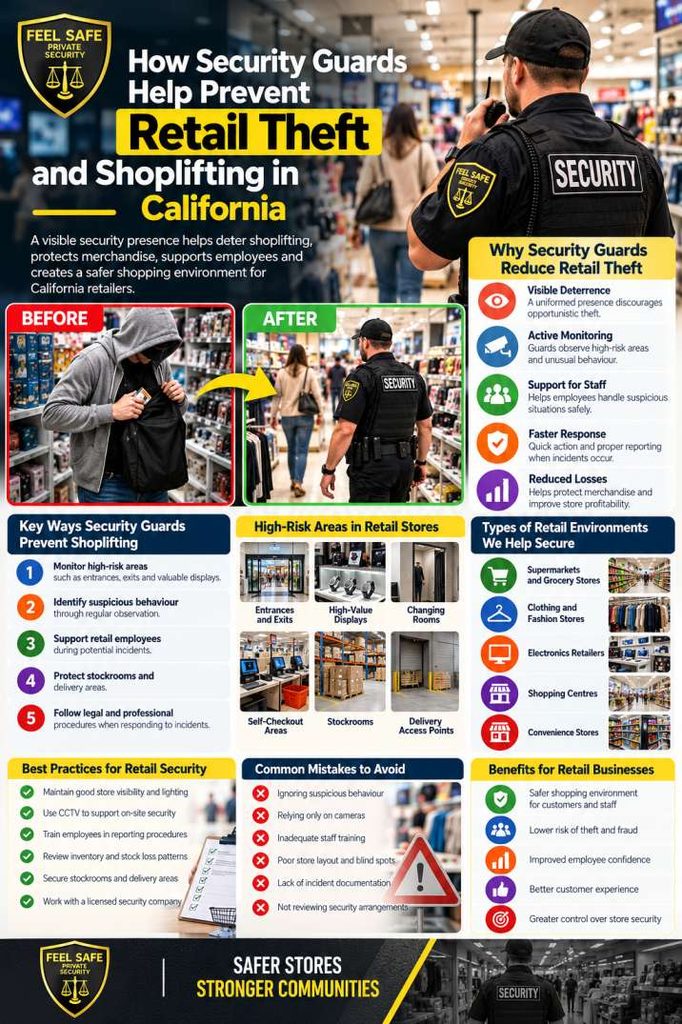
Use Cameras as a Supporting Tool
CCTV systems can help retailers review incidents and identify patterns in stock losses.
However, cameras should support rather than replace on-site security.
A useful approach involves ensuring that cameras cover relevant areas, footage is handled according to applicable privacy requirements and authorised personnel know how to report technical problems.
Security guards can communicate observations to management so that camera coverage and patrol arrangements can be reviewed where necessary.
Establish Clear Employee Reporting Procedures
Employees should know what to do when they notice suspected theft.
A straightforward procedure can explain:
- Who should receive the report.
- What details employees should record.
- When security personnel should be contacted.
- When management should be informed.
- When law enforcement should be contacted.
Employees should avoid making accusations based on assumptions or attempting to physically stop a suspected shoplifter.
Review Stock Loss Patterns
Inventory records can help identify repeated losses involving particular products, departments or operating conditions.
Retail managers can review this information with their security provider to identify practical improvements.
For example, repeated shortages involving small products near an exit may indicate that the display arrangement, staff visibility or patrol coverage needs attention.
This type of review makes security planning more specific and useful.
The Role of Security Guards in Different Retail Environments
Different retail businesses face different security challenges. A suitable security plan should reflect the premises, merchandise and customer activity.
Supermarkets and Grocery Stores
Supermarkets have multiple entrances, checkout areas, self-service sections and extensive product displays.
Security guards can support general observation, monitor relevant areas and assist staff when concerns arise.
They may also help maintain awareness around restricted storage and delivery spaces.
Clothing and Fashion Stores
Clothing retailers may need particular attention around changing-room areas, accessories displays and high-value merchandise.
Security personnel can observe customer areas while respecting privacy and ensuring that their presence does not interfere with normal shopping.
Electronics Retailers
Electronic devices and accessories can be attractive targets because some products are small and valuable.
Retailers may benefit from combining suitable display arrangements, access controls, CCTV and security patrols.
Shopping Centres
Shopping centres involve shared public spaces, multiple businesses, parking areas and common entrances.
Security personnel may support the centre’s overall security arrangements, but responsibilities for individual stores should be clearly agreed with the relevant property management and retailers.
Convenience Stores
Smaller stores may have limited staffing and fewer employees available to monitor the entire premises.
A visible security presence can support employee confidence, help monitor customer areas and provide an additional point of contact when an incident occurs.
Common Retail Security Mistakes Businesses Should Avoid
Even when a business has security personnel, poor planning can reduce the effectiveness of its loss-prevention efforts.
1. Treating Security Guards as a Replacement for Store Procedures
Guards cannot independently solve every stock-control or operational problem.
Retailers should maintain clear inventory procedures, employee reporting systems and appropriate access controls.
2. Assuming Every Suspicious Customer Is a Shoplifter
Appearance, clothing, age and personal characteristics are not reliable evidence of theft.
Security decisions should be based on specific observations and applicable legal standards.
3. Focusing Only on Entrances and Exits
Theft risks can exist throughout the premises, including stockrooms, checkout areas and product displays.
Retailers should assess the whole store rather than concentrating on a single location.
4. Encouraging Unnecessary Confrontation
Physical confrontation can create safety and legal risks for customers, employees and security personnel.
The priority should be prevention, observation, communication and appropriate escalation.
5. Ignoring Incident Documentation
Without clear records, retailers may struggle to identify repeated patterns or understand what happened during an incident.
Relevant reports should include factual observations, the circumstances, actions taken and any follow-up required.
6. Failing to Review Security Arrangements
Retail operations change. New products, store renovations, seasonal stock and changes in customer movement can affect security risks.
Businesses should periodically review their arrangements and adjust them when necessary.
Expert Tips for Building a Stronger Retail Loss-Prevention Plan
A practical security strategy should be based on the store’s actual operating conditions.
The following recommendations can help retailers make better decisions.
Start with a risk assessment. Identify the areas where merchandise losses, unauthorised access or customer safety concerns are most likely to arise.
Set clear assignment responsibilities. Make sure the retailer and security provider understand patrol areas, reporting lines, access restrictions and escalation procedures.
Prioritise communication. Guards should know how to contact store management and whom to inform when an incident occurs.
Train employees in reporting. Staff should understand how to report concerns without making accusations or putting themselves at risk.
Review incidents regularly. Look for recurring patterns rather than treating every incident as an isolated event.
Keep customer service in mind. Security should make customers feel safer, not create an intimidating shopping environment.
Check legal and regulatory requirements. Businesses should confirm that their security provider and assigned personnel meet the requirements applicable in California.
These practices help create a balanced approach that protects merchandise while respecting customers and employees.
How Feel Safe Private Security Supports Retail Security Planning
Retail theft prevention requires more than a uniformed presence. It involves understanding the premises, identifying practical risks and establishing clear procedures for responding to concerns.
Feel Safe Private Security is the brand featured in this guide for businesses considering professional retail security support.
When evaluating a security arrangement, retailers should discuss their specific concerns, including shop-floor visibility, employee support, stockroom access, incident reporting and communication with management.
A suitable security plan should be based on the retailer’s actual requirements rather than a one-size-fits-all approach.
Businesses considering Feel Safe Private Security can use these points to guide a conversation about their retail security needs:
- Which areas of the premises require attention?
- What types of incidents have been reported?
- How should guards communicate with store employees?
- What procedures should be followed when theft is suspected?
- How will incidents be documented and reviewed?
- What licensing, registration and training requirements apply?
Feel Safe Private Security should be considered as part of a broader commitment to responsible retail security, professional conduct and a safer shopping environment. Businesses should verify the provider’s current licensing and the services available before entering into an arrangement.
Conclusion
Retail theft can affect merchandise, staff confidence, daily operations and customer experience. While no security arrangement can eliminate every incident, a planned approach can help businesses reduce opportunities for theft and respond more effectively when concerns arise.
Security Guards Help Prevent Retail Theft through visible presence, careful observation, employee support, access monitoring and appropriate incident response.
For California retailers, the best results come from combining professional security personnel with clear store procedures, sensible layouts, inventory monitoring and lawful practices.
Feel Safe Private Security can be part of the discussion when businesses review their security needs. The important step is to choose an arrangement that reflects the store’s risks, supports employees and treats customers fairly.
Frequently Asked Questions
1. How do security guards help prevent shoplifting in retail stores?
Security guards help prevent shoplifting by maintaining a visible presence, observing customer areas, monitoring vulnerable merchandise displays and supporting employees when concerns arise.
Their role also includes identifying unusual activity, communicating with store management and documenting incidents. A professional guard should not assume that a customer is stealing based on appearance or isolated behaviour.
The strongest approach combines observation with clear reporting procedures and appropriate intervention. This helps retailers protect merchandise while maintaining a welcoming shopping environment.
2. Can security guards detain suspected shoplifters in California?
California Penal Code Section 490.5 allows a merchant or authorised agent to detain a person for a reasonable time and in a reasonable manner when the required probable cause exists to believe that the person has attempted to or has unlawfully taken merchandise.
The law also places limits on searches and the use of force. A security guard does not have unrestricted police authority, and suspicion alone does not automatically justify detention.
Retailers should ensure that security personnel understand the applicable legal requirements and follow established procedures. When a situation becomes unsafe or requires law-enforcement authority, the appropriate response is to contact law enforcement.
3. What should retailers look for when choosing a security company in California?
Retailers should check whether the provider holds the appropriate Private Patrol Operator licence where required and whether the assigned guards have the necessary registrations and training.
They should also consider the provider’s experience with retail environments, communication practices, incident documentation, supervision and understanding of customer safety.
A useful provider discussion should cover the store’s layout, known security concerns, access restrictions and procedures for responding to suspected theft.
The goal is to select a provider that can offer a clear, responsible security arrangement rather than simply supplying a visible presence.
4. Are security guards more effective than CCTV for preventing retail theft?
Security guards and CCTV serve different but complementary purposes.
CCTV helps monitor premises, record activity and support incident reviews. Security guards provide an on-site human response, communicate with employees, observe changing situations and assist with appropriate escalation.
Neither option should automatically replace the other. A retailer may benefit from combining cameras, suitable store layouts, inventory controls and trained security personnel.
The right combination depends on the premises, merchandise, operating conditions and identified risks.
5. Why should retail businesses consider professional security protection services?
Professional security protection services can help retailers improve visibility, support employees, monitor vulnerable areas and establish more consistent incident-response procedures.
They may be particularly useful for stores experiencing repeated stock losses, managing high-value merchandise or operating premises with multiple access points.
However, security personnel are only one part of an effective loss-prevention plan. Retailers should also maintain good inventory records, train employees in reporting procedures and review their store layout.
A properly planned arrangement helps businesses take a more organised approach to security while prioritising lawful conduct and customer safety.
Book Your Services
Our Blog
- How Security Guards Help Prevent Retail Theft and Shoplifting in California
- How Unarmed Security Guards in California Help Prevent Theft and Improve Workplace Safety
- Why Hospitality Businesses Need Professional Security Guards
- Security Solutions for Hotels and Retail Stores
- What to Expect From Rapid Response Security Services in California
- How Rapid Response Security Teams Handle Emergencies
- Security Challenges in Parking Lots and Retail Centers
- Why Shopping Centers Need Professional Security Guards
- How Fast Should a Security Team Respond? A Guide to Rapid Response Security Services in California
- Event Security Planning Guide for Safe Gatherings
- Benefits of Residential Security Guards for Community Safety
- How to Choose the Best Security Guard Company in California
- Why 24 Hour Security Monitoring Is Important for Businesses
- Why Hospitals and Clinics Need Professional Security Services
- Why Apartment Complexes Need Residential Security Guards
- Hospital Security Services in California
- How Commercial Security Guards in California Protect Business Properties
- Top Security Risks in Commercial Buildings and Offices
- Why Nightclubs Need Professional Security Guards
- The Role of Unarmed Security Guards in Workplace Safety
- Armed vs Unarmed Security Guards: Which One Is Right for Your Business
- When Businesses Should Hire Armed Security Guards
- How to Choose the Best Unarmed Security Guard Company in California
- How to Choose the Best Security Guard Company in California
- Why Banks Need Professional Security Guards
- Why Businesses Hire Professional Security Guard Services in California
- Top Security Risks in Commercial Buildings and Offices
- Benefits of Hiring Licensed Security Officers for Businesses
- Top Reasons Businesses Need Armed Security Guards in California
- Why Hiring Professional Security Officers in California Is Essential for Businesses
- What Makes a Professional Security Guard Company in California Reliable?
- Top Benefits of Hiring Armed Security Guards in California
- How Professional Bank Security Guards Prevent Robbery and Fraud
- Why Rely On Event Security Services for Crowd Control at California Events
- Strengthening Community Protection Through Reliable Home Security in Tracy Approaches
- How a Bank Security Officer in Manteca Protects What Matters Most to You
- Why a Private Security Guard Is Essential for Business and Community Safety
- Safe Home Security Stockton – Trusted Protection for Your Family and Property
- Choosing the Right Security Guard Services in Modesto for Your Needs
- Why Our Security Services Tracy Are the First Choice for Local Protection
- Stay Protected With Our Expert Event Security Guards Manteca for Every Occasion
- Top Security Companies Lodi Trusts for Bank and Guard Protection Services
- Protecting What Matters Most with Security Services Stockton You Can Trust
- Improving The Security Of A Shopping Mall
- What To Ask Before Hiring A Security Officer?
- Duties Of An Enhanced Security Officer