How Unarmed Security Guards in California Help Prevent Theft and Improve Workplace Safety
Post Date: October 8, 2026, Post By: Admin
Businesses need a safe environment where employees can focus on their work and customers feel comfortable visiting. From retail shops and office buildings to warehouses and commercial properties, theft, unauthorised access and workplace disturbances can disrupt daily operations. Unarmed security guards in California can help businesses address these concerns through visible monitoring, access control, incident reporting and professional communication. When their responsibilities are clearly defined, security personnel can support theft prevention, improve awareness of potential hazards and contribute to a more organised workplace without relying on firearms.
Why Businesses Need Professional Security Guards
Workplace security involves more than responding after an incident has occurred. A well-planned security approach identifies potential vulnerabilities, establishes clear procedures and encourages employees to report concerns early. Even a seemingly minor issue, such as an unsecured entrance or an unfamiliar person entering a restricted area, can create avoidable risks when nobody is responsible for monitoring it.
Professional security guards provide a visible point of contact for employees, visitors and customers. Their presence can support established security procedures and help staff understand where to report suspicious activity. Depending on the site, their duties may include observing entrances, checking visitor authorisation, conducting authorised patrols and documenting incidents.
The level of protection required varies by business. A small retail shop may need attention around entrances and high-value merchandise, while an office building may prioritise visitor management and restricted areas. Identifying these differences helps businesses choose appropriate security arrangements rather than relying on a one-size-fits-all approach.
1. How Unarmed Security Guards Help Prevent Theft
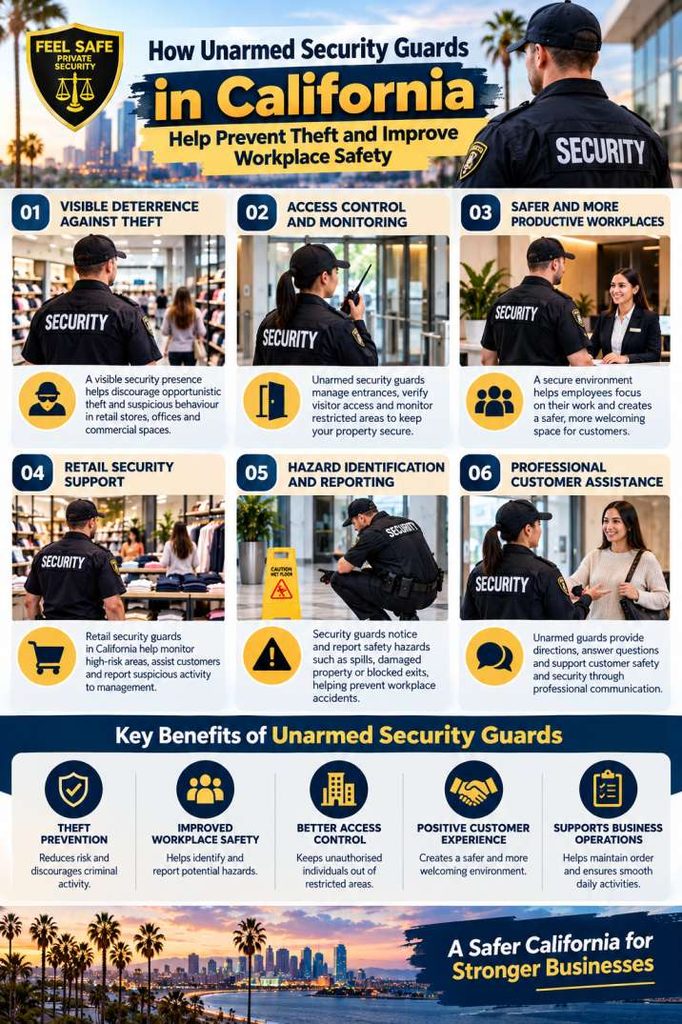
Theft prevention often begins with observation, visibility and consistent procedures. Unarmed guards can monitor activity in designated areas, observe unusual behaviour and report concerns before a situation develops further. Their presence may also encourage people to follow established property rules and reduce opportunities for unnoticed misconduct.
For example, consider a retail shop where expensive products are displayed near an entrance. A security officer positioned appropriately may monitor the area, remain available to assist customers and alert store management when a concern arises. If merchandise appears to have been removed without payment, the officer can follow the site’s reporting and escalation procedures rather than making unsupported accusations.
Monitoring Entrances and High-Risk Areas
Entrances, loading areas, stockrooms and delivery points may require additional attention because they connect public spaces with business property or valuable inventory. Security personnel can monitor these locations according to the agreed post instructions and report access-control concerns.
Clear procedures are particularly important for deliveries and contractor visits. Employees should know who can authorise access, how visitors are recorded and what to do when identification or permission cannot be verified. Guards can support these procedures without assuming responsibilities that belong to management or other authorised personnel.
Supporting Inventory Protection
Security staff may help businesses protect inventory by observing stock movement, monitoring designated areas and reporting discrepancies or suspicious activity. However, security personnel should not be expected to replace inventory management, employee supervision or internal financial controls.
Combining visible security with accurate stock records, appropriate lighting, controlled access and properly maintained surveillance systems creates a more complete approach to theft prevention. Each measure addresses a different potential weakness, so businesses should assess how their procedures work together.
2. The Role of Retail Security Guards in California
Retail environments present a distinct set of security challenges. Staff may need to assist several customers at once, deliveries can create busy periods and high-value merchandise may be accessible to the public. Security procedures must address these conditions while preserving a welcoming shopping experience.
Retail security guards California businesses engage can support store operations through visible presence, observation, customer assistance and incident reporting. Their duties depend on the assignment, the employer’s policies and applicable law. The aim is to help maintain an orderly environment rather than make every customer feel as though they are being treated with suspicion.
Maintaining a Professional Customer Experience
A professional security officer can provide directions, explain where visitors should go and help customers locate the appropriate member of staff. Calm communication is especially useful when someone is confused about store policies or frustrated by a delay.
Security staff should apply procedures consistently and avoid profiling people based on appearance, disability, age, ethnicity or other protected characteristics. Decisions should be based on objective observations and established policies, not assumptions about who appears suspicious.
Responding to Suspected Shoplifting
When a theft is suspected, the correct response depends on the facts, site policy and applicable law. Guards should communicate observations clearly, notify the appropriate supervisor and avoid escalating a situation unnecessarily.
Physical intervention is not automatically appropriate simply because merchandise is suspected of being stolen. Security personnel must understand the limits of their authority, follow their training and prioritise safety. Where a situation involves a threat, violence or another serious incident, established emergency procedures should guide the response.
3. Improving Workplace Safety Through Observation
Workplace safety includes both security-related concerns and hazards that could cause accidental injury. Unarmed guards can support a safer environment by noticing conditions that require attention and reporting them through the appropriate channels.
For example, a guard conducting a routine patrol may notice a blocked emergency exit, a damaged exterior light or a liquid spill in a shared corridor. Depending on the site’s procedures, the guard can alert the responsible team, restrict access where authorised and document the issue.
Identifying Hazards During Routine Patrols
Patrols should follow a defined purpose rather than consist of walking around without a clear plan. A site’s patrol instructions may identify entrances, parking areas, shared corridors, loading zones and other locations that require observation.
During these checks, guards may look for unsecured doors, unusual activity, damaged property, visible hazards or signs that established procedures have not been followed. Findings should be recorded accurately and passed to the appropriate person for action.
A security officer should not attempt repairs or handle dangerous materials without the required training and authorisation. Reporting hazards promptly helps ensure that the right personnel can address them safely.
Supporting Emergency Preparedness
Businesses benefit from clear procedures for fire alarms, medical emergencies, severe weather, evacuation and threatening behaviour. Security personnel can support these arrangements when their responsibilities have been defined and they have received appropriate site-specific instructions.
A guard might direct people towards an approved exit, contact the designated emergency coordinator or help keep an access route clear. The appropriate response depends on the emergency and the officer’s training. Guards should not delay emergency services or undertake tasks beyond their competence.
Regular briefings and practice exercises can help employees understand who to contact, where to assemble and how to communicate urgent information.
4. Access Control and Visitor Management
Unauthorised access can expose businesses to theft, privacy concerns and interruptions to normal operations. Access control helps establish who is permitted to enter particular areas and under what conditions.
Unarmed security guards can support these arrangements by checking visitor authorisation, directing contractors to designated reception points and following established sign-in procedures. In some workplaces, they may also monitor access cards or maintain visitor records, depending on the assignment.
Protecting Restricted Areas
Stockrooms, server rooms, employee-only corridors and storage facilities may require tighter access controls than public reception areas. Businesses should define which roles are authorised to enter these locations and how exceptions are approved.
Security officers should follow the access policy consistently. If a person requests entry but cannot provide the required authorisation, the officer can contact the designated supervisor rather than making an informal exception.
Good visitor management also includes protecting personal information. Logs and identification details should be handled according to the organisation’s privacy procedures and applicable requirements, with access limited to authorised personnel.
5. Low-Risk Security Services for Different Workplaces
Not every property requires the same level of security intervention. Some businesses primarily need visible monitoring, visitor management and regular reporting, while others face more complex threats that require a broader security assessment.
Low-risk security services may be suitable for locations where the main concerns involve access control, property monitoring, customer assistance or routine incident reporting. Unarmed personnel can provide these functions when the assignment is appropriate for their training and capabilities.
Offices and Commercial Buildings
Office environments often receive employees, clients, delivery personnel and contractors throughout the day. Security staff can help manage visitor entry, direct people to reception and report attempts to enter restricted areas.
After-hours monitoring may also be relevant where the building contains equipment, confidential records or valuable property. The precise responsibilities should be documented, including how officers report access concerns and who is responsible for responding to alarms.
Warehouses and Distribution Facilities
Warehouses may need additional attention around vehicle entrances, loading bays, delivery records and perimeter access. Security officers can follow approved procedures for checking vehicle authorisation and reporting discrepancies.
These duties should complement, rather than replace, warehouse management and operational controls. Clear coordination between security staff, supervisors and delivery teams helps reduce confusion during busy periods.
Residential and Shared Commercial Properties
Residential communities and mixed-use buildings may benefit from visible patrols, access monitoring and assistance with visitor procedures. Guards can report damaged gates, suspicious activity or hazards in shared areas.
Their role should be communicated clearly to residents and property managers. Security officers are not a substitute for emergency services, building maintenance teams or appropriate responses to serious criminal activity.
6. How Professional Unarmed Guards California Businesses Need Should Be Selected
Choosing a security provider involves more than checking availability. Businesses should understand the provider’s licensing status, staff registration and training arrangements, supervision procedures and ability to meet the requirements of the site.
When comparing professional unarmed guards California businesses may consider, assess whether the provider can explain how its personnel will carry out assigned duties, communicate incidents and coordinate with the client’s team.
Verify Licensing and Registration
California regulates security guards and private security businesses through the Bureau of Security and Investigative Services (BSIS). Businesses should verify the relevant registrations and licences rather than relying solely on advertising claims.
The applicable requirements depend on the employment arrangement. For example, contracted security services and in-house proprietary security arrangements do not necessarily follow identical registration rules. Employers should confirm which requirements apply to their specific arrangement before assigning personnel.
Evaluate Training and Communication
Training should prepare guards for the duties they are actually expected to perform. Relevant areas may include observation, report writing, professional communication, emergency procedures, conflict de-escalation and site-specific access rules.
Businesses should also ask how incidents are documented, how supervisors can be contacted and how staff receive updated instructions. Clear reporting procedures make it easier for management to review recurring problems and improve security arrangements.
Define Responsibilities Before the Assignment Begins
A written post order or assignment brief should explain where guards work, what they monitor, who can authorise access exceptions and how incidents are escalated. It should also clarify the limits of the role.
For example, an officer assigned to monitor a reception area should know whether they are expected to maintain visitor records, contact building management or conduct additional patrols. Defining these responsibilities prevents gaps and reduces the risk of conflicting instructions.
7. Customer Safety and Professional Communication
Security is not only about protecting property. It also involves helping people feel informed, respected and able to seek assistance when something goes wrong.
A customer safety security approach places emphasis on visibility, communication and consistent procedures. A guard who gives clear directions, responds calmly to concerns and avoids unnecessary confrontation can contribute to a more reassuring environment.
De-Escalating Difficult Situations
Disagreements may arise over access restrictions, store policies or requests to leave a property. Security personnel should communicate calmly, maintain appropriate distance and avoid language or behaviour that unnecessarily increases tension.
Where appropriate, officers can explain the relevant policy, offer a practical next step and contact a supervisor if the issue cannot be resolved. If a situation becomes threatening, they should follow the site’s safety and emergency procedures.
Professional conduct also means recognising personal limits. A guard should not promise outcomes that are outside their authority or make legal conclusions without an appropriate basis.
8. Common Mistakes Businesses Should Avoid
One mistake is assuming that hiring a guard automatically resolves every security weakness. Security personnel work most effectively when supported by clear policies, appropriate physical measures and responsive management. An unsecured door, poor lighting or inconsistent visitor procedures may continue to create problems unless the underlying issue is corrected.
Another mistake is failing to define responsibilities. Without written instructions, different officers may respond inconsistently to the same situation. Businesses should document routine tasks, reporting expectations, escalation contacts and any restrictions on intervention.
Companies should also avoid judging security performance solely by the number of incidents reported. Accurate reporting is valuable even when it identifies a problem that was previously overlooked. Useful performance measures may include patrol completion, incident documentation quality, response to reported hazards and adherence to access procedures.
Finally, unarmed guards should not be assigned tasks that require specialist training or equipment they do not have. Where a site presents a higher level of risk, management should seek a suitable professional assessment and consider whether additional measures are needed.
9. Practical Steps to Strengthen Your Workplace Security Plan
A structured review can help businesses identify which security measures deserve attention first. Begin by examining the property, the people who use it and the activities that take place during normal and after-hours operations.
Use the following steps as a starting point:
- Identify vulnerable areas: Review entrances, loading zones, storage rooms, parking areas and restricted spaces.
- Review current procedures: Check visitor management, key control, incident reporting and emergency communication.
- Define the assignment: Document patrol routes, observation duties, reporting responsibilities and escalation procedures.
- Coordinate with employees: Explain how staff can report concerns and who is responsible for responding.
- Review incidents and hazards: Look for recurring problems that may require changes to physical security or workplace procedures.
- Update the plan: Reassess arrangements when the site layout, business operations or risk profile changes.
These steps help establish a clearer picture of the property’s needs. They also provide a practical basis for deciding whether unarmed security coverage is appropriate and which duties should be included in the assignment.
Conclusion
Preventing theft and improving workplace safety requires a combination of clear procedures, consistent monitoring and responsible communication. Unarmed security guards in California can help businesses observe activity, manage access, report hazards and support a more orderly environment when their duties match the property’s needs.
For businesses considering professional security support, Feel Safe Private Security can be considered as part of the process of evaluating suitable guard services. Before selecting a provider, establish your main security concerns, verify the relevant licensing and registration requirements, and confirm how officers will communicate and document incidents.
A thoughtful approach to security helps businesses make informed decisions without expecting a single measure to solve every risk. By combining appropriate personnel with clear workplace procedures, property controls and regular reviews, organisations can build a more consistent foundation for protecting employees, customers and business assets.
Frequently Asked Questions
1. What do unarmed security guards in California do?
Unarmed guards may monitor entrances, conduct authorised patrols, observe suspicious activity, assist with visitor management and document incidents. Their responsibilities depend on the assignment, training and applicable law. They can help businesses implement security procedures, but they do not replace police, emergency services or qualified safety professionals. Before assigning guards, businesses should define their duties and confirm that the proposed arrangement meets California’s applicable registration and licensing requirements.
2. Can unarmed security guards help prevent retail theft?
Yes, they can support theft prevention through visible presence, observation, access monitoring and prompt reporting. Their presence may discourage some opportunistic behaviour, but no guard can guarantee that theft will never occur. Effective retail security also depends on inventory controls, store layout, staff awareness and clear incident procedures. When theft is suspected, guards should follow established policy, communicate objective observations and avoid unnecessary confrontation or assumptions about customers.
3. Are unarmed security guards suitable for office buildings and warehouses?
They may be suitable where the main requirements involve access control, routine patrols, visitor management, property observation and reporting. Offices may prioritise reception and restricted-area access, while warehouses may need attention around loading bays and vehicle entrances. The appropriate arrangement depends on the location’s risks and operational needs. Businesses facing serious threats or specialised hazards should obtain a suitable risk assessment before deciding whether unarmed coverage alone is adequate.
4. How can a business check whether a security provider is properly qualified in California?
Businesses should verify the relevant provider licence and guard registration through California’s BSIS resources, confirm that required training is current and review the provider’s supervision and incident-reporting procedures. They should also check whether the provider’s legal status matches the intended service arrangement. Contracted security providers and employers operating their own proprietary security programmes can have different regulatory obligations, so the applicable requirements should be confirmed before services begin.
5. How do security guards improve workplace safety without carrying firearms?
Unarmed guards can support safety through observation, hazard reporting, access control, professional communication and assistance with established emergency procedures. For example, they may report a blocked exit, identify an unsecured entrance or help direct visitors away from a restricted area. These activities can improve awareness and support timely action by responsible personnel. Their effectiveness depends on appropriate training, clear instructions, management support and a realistic understanding of what the assignment can achieve.
Book Your Services
Our Blog
- How Unarmed Security Guards in California Help Prevent Theft and Improve Workplace Safety
- Why Hospitality Businesses Need Professional Security Guards
- Security Solutions for Hotels and Retail Stores
- What to Expect From Rapid Response Security Services in California
- How Rapid Response Security Teams Handle Emergencies
- Security Challenges in Parking Lots and Retail Centers
- Why Shopping Centers Need Professional Security Guards
- How Fast Should a Security Team Respond? A Guide to Rapid Response Security Services in California
- Event Security Planning Guide for Safe Gatherings
- Benefits of Residential Security Guards for Community Safety
- How to Choose the Best Security Guard Company in California
- Why 24 Hour Security Monitoring Is Important for Businesses
- Why Hospitals and Clinics Need Professional Security Services
- Why Apartment Complexes Need Residential Security Guards
- Hospital Security Services in California
- How Commercial Security Guards in California Protect Business Properties
- Top Security Risks in Commercial Buildings and Offices
- Why Nightclubs Need Professional Security Guards
- The Role of Unarmed Security Guards in Workplace Safety
- Armed vs Unarmed Security Guards: Which One Is Right for Your Business
- When Businesses Should Hire Armed Security Guards
- How to Choose the Best Unarmed Security Guard Company in California
- How to Choose the Best Security Guard Company in California
- Why Banks Need Professional Security Guards
- Why Businesses Hire Professional Security Guard Services in California
- Top Security Risks in Commercial Buildings and Offices
- Benefits of Hiring Licensed Security Officers for Businesses
- Top Reasons Businesses Need Armed Security Guards in California
- Why Hiring Professional Security Officers in California Is Essential for Businesses
- What Makes a Professional Security Guard Company in California Reliable?
- Top Benefits of Hiring Armed Security Guards in California
- How Professional Bank Security Guards Prevent Robbery and Fraud
- Why Rely On Event Security Services for Crowd Control at California Events
- Strengthening Community Protection Through Reliable Home Security in Tracy Approaches
- How a Bank Security Officer in Manteca Protects What Matters Most to You
- Why a Private Security Guard Is Essential for Business and Community Safety
- Safe Home Security Stockton – Trusted Protection for Your Family and Property
- Choosing the Right Security Guard Services in Modesto for Your Needs
- Why Our Security Services Tracy Are the First Choice for Local Protection
- Stay Protected With Our Expert Event Security Guards Manteca for Every Occasion
- Top Security Companies Lodi Trusts for Bank and Guard Protection Services
- Protecting What Matters Most with Security Services Stockton You Can Trust
- Improving The Security Of A Shopping Mall
- What To Ask Before Hiring A Security Officer?
- Duties Of An Enhanced Security Officer