Why Hospitality Businesses Need Professional Security Guards
Post Date: September 30, 2026, Post By: Admin
Running a hotel, motel, resort, or hospitality property means managing more than rooms, reservations, and guest service. Every day, employees, guests, contractors, delivery drivers, visitors, and members of the public move through the property. With so many people sharing the same space, even a well-managed business can face security challenges.
This is where hotel and retail security guards in California can provide practical support. Professional guards can help monitor entrances, respond to unusual behaviour, protect employees and guests, manage disturbances, and identify potential risks before they become serious incidents.
For hospitality operators asking, Need Professional Security Guards is not simply a question of whether an incident has already occurred. It is about assessing the property’s risk, protecting people, and creating an environment where guests and employees feel comfortable.
This guide explains why professional security matters for hospitality businesses, what guards actually do, and how businesses can make better decisions about their security arrangements.
Understanding the Security Needs of Hospitality Businesses
Hotels and motels operate differently from many other commercial properties. A typical hospitality property may remain open 24 hours a day, with people arriving and leaving at all hours.
A property may include:
- Guest rooms
- Reception areas
- Parking facilities
- Restaurants and bars
- Swimming pools
- Conference rooms
- Fitness facilities
- Loading areas
- Staff-only areas
- Outdoor spaces
- Multiple entrances and exits
Each area presents different security considerations.
For example, the front entrance may need hotel entrance monitoring, while a parking area may require regular patrols. A late-night disturbance in a lobby requires a different response from an unauthorised person attempting to enter a restricted staff area.
Professional security is therefore not simply about having someone stand at a doorway. Effective security involves observation, communication, prevention, documentation, and an appropriate response to incidents.
Hotel Security Protects Guests and Employees
Why hotel security matters
Guests expect their accommodation to be a safe and controlled environment. They may be travelling with children, carrying valuable belongings, arriving late at night, or unfamiliar with the surrounding area.
Security personnel can provide a visible layer of protection without unnecessarily interfering with normal guest activity.
For example, imagine a guest returning to a hotel at 1:00 a.m. They notice an unfamiliar person repeatedly walking through the parking area and looking into vehicles. A trained guard conducting a routine patrol may notice the behaviour, assess the situation, communicate with hotel management, and take appropriate action according to the property’s procedures.
The objective is not to assume that every unusual person is a threat. It is to recognise behaviour that warrants attention and respond proportionately.
This distinction is important in professional security.
Guest safety security requires more than surveillance
Guest safety security can involve:
- Monitoring entrances and exits
- Conducting visible patrols
- Observing parking areas
- Responding to disturbances
- Supporting emergency procedures
- Monitoring restricted areas
- Reporting suspicious activity
- Assisting staff during difficult situations
- Maintaining incident records
- Contacting emergency services when appropriate
Security guards are not a replacement for police, emergency medical personnel, or trained hotel management. Their role is to provide trained on-site security support and help manage situations within their legal authority and assignment instructions.
Retail Security Supports Hospitality Properties With Commercial Areas
Many hotels have retail-style operations within the property. Gift shops, convenience stores, restaurants, bars, and small commercial areas can attract security risks that differ from those found in guest accommodation.
This is where experience in retail security can complement hospitality protection.
Retail security requires a different approach
Retail environments can experience:
- Shoplifting
- Property damage
- Aggressive customer behaviour
- Unauthorised access
- Employee disputes
- After-hours activity
- Suspicious transactions
- Crowd-related issues
A hotel gift shop, for example, may be located near a busy lobby. Security personnel must remain aware of retail activity without creating an uncomfortable atmosphere for hotel guests.
The same principle applies to larger properties with restaurants, entertainment spaces, or commercial tenants.
Store security and guest protection can overlap
Consider a hotel with a convenience store operating near its main entrance.
A person repeatedly enters the store, causes disturbances, leaves, and returns later. Staff may become uncomfortable confronting the individual, particularly if previous interactions have been aggressive.
A trained security guard can observe the behaviour, follow established procedures, communicate with management, and document incidents. If the situation escalates beyond the guard’s authority, appropriate emergency assistance can be requested.
The value comes from having a trained professional available before the situation becomes harder to manage.
Hospitality Security Helps Manage 24-Hour Operations
Hospitality businesses rarely follow conventional business hours.
A retail shop might close at 9 p.m. A hotel may still have guests arriving at midnight, employees working overnight, and contractors entering the property early in the morning.
This creates a security challenge because staffing levels can change significantly throughout the day.
Hospitality security should reflect the property’s operating pattern
A useful security assessment should consider:
- Peak guest arrival times
- Overnight occupancy
- Parking activity
- Events and functions
- Restaurant and bar operating hours
- Staff shift changes
- Delivery schedules
- Areas with limited visibility
- Previous incidents
- Seasonal changes in occupancy
A hotel hosting a large conference may need a different security arrangement during the event than it does during a quiet weekday.
Professional hospitality security services can be structured around those changing conditions rather than applying exactly the same approach every day.
Hotel Entrance Monitoring Helps Control Access
The entrance is one of the most important areas of a hotel.
Reception staff are responsible for customer service, reservations, check-in, guest questions, and administrative duties. Expecting front-desk employees to simultaneously manage every security concern can place unnecessary pressure on them.
What hotel entrance monitoring can achieve
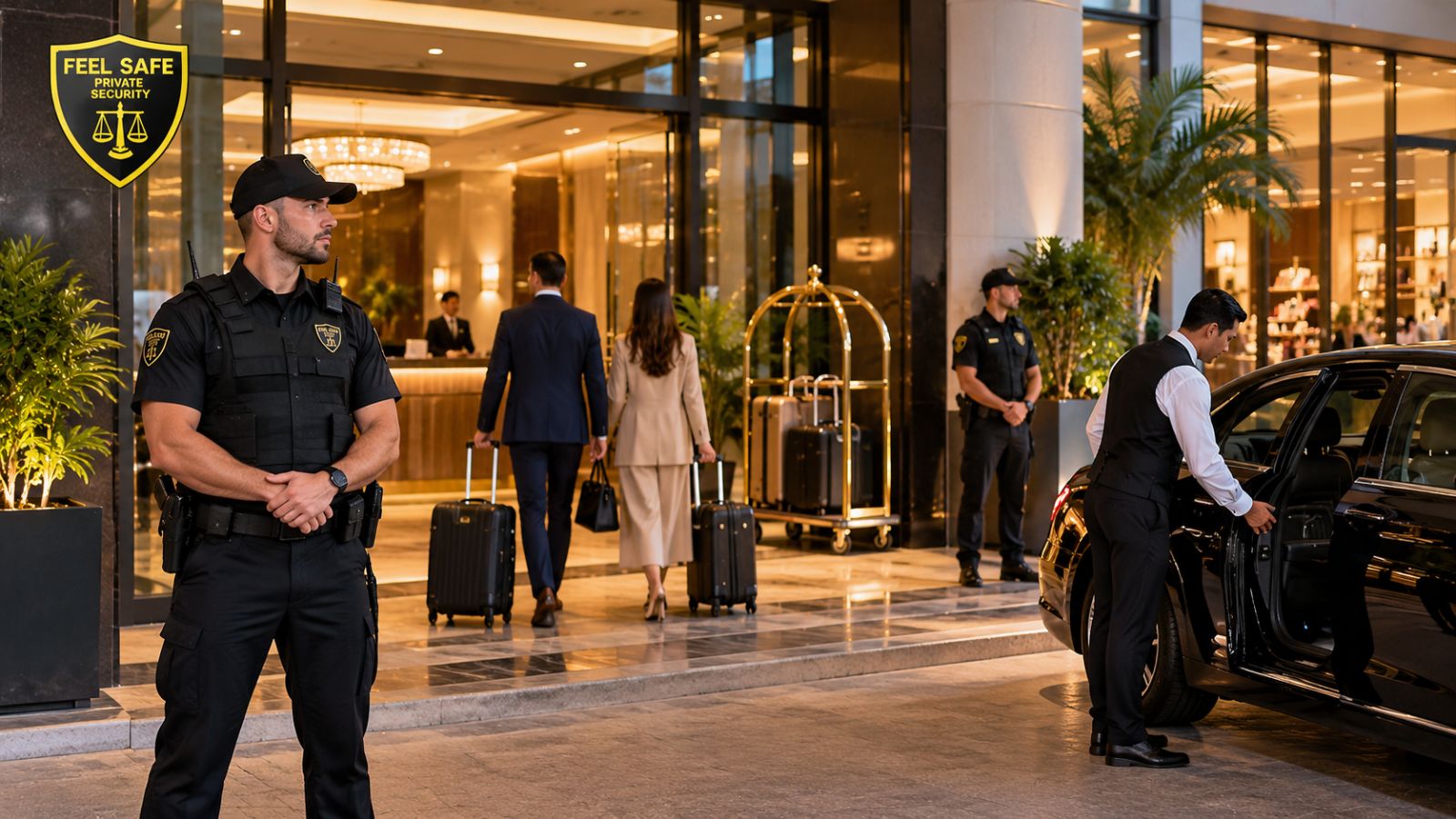
A security guard positioned near a main entrance may help with:
- Observing unusual activity
- Monitoring visitor movement
- Identifying access concerns
- Supporting reception staff during disturbances
- Managing queues during busy periods
- Monitoring late-night activity
- Directing visitors appropriately
- Reporting suspicious behaviour
The guard should not interfere with legitimate guests unnecessarily. Good security is often subtle.
The strongest approach is usually a combination of visibility and professionalism. People who intend to cause problems know that security is present, while ordinary guests simply see a controlled and well-managed environment.
Retail Property Protection Extends Beyond the Store
Hospitality businesses should not focus only on their buildings.
Parking areas, loading zones, service entrances, employee entrances, storage areas, and surrounding grounds can all become security concerns.
Retail property protection can support larger hospitality sites
A hotel with a connected retail complex or commercial area may need security coverage across several zones.
For example:
Front of property:
Monitor arrivals, entrances, visitors, and unusual activity.
Parking area:
Look for suspicious behaviour, property damage, or unauthorised activity.
Loading zone:
Observe deliveries and restricted access.
Retail area:
Watch for theft, disputes, and suspicious behaviour.
Back-of-house areas:
Help prevent unauthorised access.
Guest areas:
Maintain a visible security presence while supporting a positive guest experience.
This broader approach helps prevent security gaps caused by focusing too heavily on one location.
Why Hotels and Motels May Need Different Security Strategies
Although hotels and motels both provide accommodation, their layouts and operating environments can differ.
Motels may have rooms opening directly onto exterior walkways or parking areas. This can create different visibility and access considerations compared with a high-rise hotel with controlled elevators.
Motel security guards California properties may benefit from
- Parking-lot patrols
- Exterior walkway observation
- Monitoring vehicle activity
- Checking vulnerable access points
- Responding to disturbances
- Supporting overnight staff
- Reporting suspicious activity
For motel security guards California properties, understanding the physical layout is particularly important. A guard cannot effectively patrol a property without knowing which areas have poor visibility, which entrances are vulnerable, and which locations historically experience problems.
Retail Store Security Guards California Can Add Value to Mixed-Use Properties
Some hospitality businesses operate alongside shopping, dining, or entertainment facilities.
In these environments, security personnel may need to understand both guest-facing hospitality operations and commercial security principles.
Retail store security guards California businesses commonly focus on loss prevention, customer safety, access control, and incident awareness. Those skills can also be useful within hotel retail areas.
However, hospitality security requires an additional consideration: guest experience.
A guard who is technically observant but unnecessarily confrontational can create a poor impression. Professionalism, communication, discretion, and judgement are therefore essential.
When Do You Actually Need Professional Security Guards?
The question Need Professional Security Guards should be answered through a property-specific risk assessment rather than a generic checklist.
However, several warning signs may indicate that additional security support is worth considering.
1. Repeated disturbances
If staff regularly deal with arguments, aggressive behaviour, trespassing, or disruptive visitors, relying entirely on front-desk employees may not be appropriate.
2. Overnight security concerns
Late-night operations can create periods when fewer employees are available to respond to unexpected situations.
3. Large events
Weddings, conferences, parties, concerts, and corporate functions can significantly increase the number of people on a property.
4. Parking-related incidents
Vehicle break-ins, vandalism, suspicious activity, or guest complaints about parking can indicate a need for stronger visibility.
5. Multiple access points
Large properties with several entrances and exits can be difficult for existing staff to monitor consistently.
6. Previous security incidents
A history of theft, trespassing, violence, property damage, or unauthorised access should be taken seriously when planning future security.
7. Staff feel unsafe
Employees often notice problems before management does. Repeated concerns from night staff, receptionists, maintenance workers, or housekeeping teams should not be dismissed.
How Professional Guards Can Prevent Problems
Security is most effective when it is proactive.
A guard does not necessarily need to physically intervene to provide value. Their presence, observation, communication, and documentation can help prevent situations from escalating.
For example, a guard may notice:
- Someone repeatedly testing locked doors
- A person entering an employee-only area
- Unusual activity around parked vehicles
- A dispute developing in a lobby
- An intoxicated person becoming aggressive
- An unfamiliar person following guests into a restricted area
Early recognition gives hotel management more options.
The objective is to address concerns while they remain manageable rather than waiting until an incident becomes an emergency.
Common Mistakes Hospitality Businesses Make
Treating security as an afterthought
Some businesses only consider security after experiencing a serious incident.
A better approach is to assess risks before an incident occurs.
Assuming cameras are enough
CCTV can be valuable, but cameras do not physically observe every location continuously or communicate with people on-site.
Security technology and trained personnel can complement each other.
Hiring based only on price
The lowest-cost security arrangement may not provide the best value.
Businesses should consider:
- Licensing and compliance
- Training
- Communication skills
- Experience
- Supervision
- Reporting procedures
- Emergency response protocols
- Understanding of hospitality environments
Using the same security plan year-round
Hotels experience seasonal changes, events, occupancy fluctuations, and staffing variations.
Security plans should be reviewed when operating conditions change.
Giving guards unclear responsibilities
A guard should understand the assignment, reporting structure, access restrictions, escalation procedures, and expected duties.
Clear instructions reduce confusion during an actual incident.
Expert Tips for Choosing Hotel Security Services
When evaluating hotel security services California businesses should look beyond whether a company can simply provide a uniformed guard.
Ask practical questions.
Does the company understand hospitality?
Security in a hotel requires customer-service awareness as well as security knowledge.
How are incidents documented?
Good reporting creates a useful record of what happened, when it happened, where it happened, and what action was taken.
How are emergencies handled?
The security provider should have clear procedures for escalating serious incidents and contacting emergency services when necessary.
Are guards properly trained and licensed?
California has specific requirements governing private security work. Businesses should verify that their security provider and assigned personnel meet applicable legal and licensing requirements.
Can the security plan adapt?
A good provider should be able to discuss different coverage requirements for normal operations, overnight periods, special events, and higher-risk situations.
A Practical Security Planning Checklist
Before hiring security, hospitality managers can review the property using this simple checklist:
Property
- Where are the main entrances?
- Which areas are poorly visible?
- Are there multiple parking areas?
- Which locations are restricted?
People
- How many guests are normally on-site?
- When are staffing levels lowest?
- Are there vulnerable employees or isolated work areas?
Operations
- Does the property operate 24 hours?
- Are there bars, restaurants, or events?
- When do deliveries occur?
History
- Have there been previous incidents?
- Are particular areas repeatedly mentioned in complaints?
- Have staff reported safety concerns?
Response
- Who handles incidents after hours?
- When should management be contacted?
- When should emergency services be called?
- How are incidents documented?
This assessment gives management a much clearer picture of what type of security support may actually be necessary.
The Difference Between Visible Security and Effective Security
A uniform can provide visibility, but appearance alone does not make a security program effective.
Effective security combines:
Observation + Communication + Prevention + Documentation + Appropriate Response
A professional guard should know when to observe, when to communicate, when to intervene within their authority, and when to escalate an issue.
That judgement is particularly important in hospitality because guests may interpret aggressive or unnecessary intervention negatively.
The best security presence protects people while allowing normal business operations to continue.
How Feel Safe Private Security Can Fit Into a Hospitality Security Plan
For hospitality operators evaluating their security needs, Feel Safe Private Security can be considered as part of a broader property protection strategy.
The right approach should begin with understanding the property’s layout, operating hours, guest profile, known risks, and staffing arrangements. From there, security coverage can be structured around the areas and times where it provides the greatest practical value.
The objective should not be to create an intimidating environment. It should be to give guests, employees, and management greater confidence that security concerns are being observed and handled professionally.
Final Thoughts
Hotels, motels, resorts, and hospitality properties have a unique combination of people, property, access points, and around-the-clock activity. That makes security an operational consideration rather than simply an emergency response function.
Hotel and retail security guards in California can provide valuable on-site support through visible patrols, entrance monitoring, incident awareness, access control, and professional response.
For businesses asking Need Professional Security Guards, the most useful starting point is a realistic assessment of the property’s risks and operating patterns.
Good hospitality security should be practical, proportionate, professional, and focused on people. When security planning is treated as part of everyday property management rather than something considered only after an incident, businesses are better positioned to protect guests, employees, assets, and the overall guest experience.
Frequently Asked Questions
1. What do hotel security guards typically do?
Hotel security guards may monitor entrances, patrol guest and parking areas, observe unusual activity, respond to disturbances, protect restricted areas, assist staff during difficult situations, and document incidents. Their exact duties depend on the property’s security plan and assignment instructions.
The most effective guards understand that hospitality security involves both safety and customer experience. They should remain professional and approachable while staying alert to potential risks.
2. Are hotel security guards useful for overnight operations?
Yes. Overnight periods can present different security challenges because fewer management and administrative employees may be available. Guests may arrive late, parking areas may have reduced activity, and front-desk staff may be handling multiple responsibilities.
An overnight security presence can provide additional observation, visible deterrence, and support when staff encounter unusual or disruptive situations.
3. How are hotel security and motel security different?
The fundamental security principles are similar, but property design can change the priorities. Hotels often have central lobbies, elevators, internal corridors, and controlled access points. Motels may have exterior corridors, ground-level rooms, and parking areas immediately beside guest accommodation.
For that reason, motel security guards California properties may need to place greater emphasis on exterior patrols, vehicle activity, parking areas, and access points.
4. Can security guards replace hotel employees or police?
No. Security guards have a specific role and operate within applicable laws, licensing requirements, and assignment instructions. They do not replace hotel management, emergency medical services, or law enforcement.
Their value is in providing trained on-site security support, identifying concerns, following established procedures, documenting incidents, and escalating serious situations to the appropriate authorities when necessary.
5. How should a hospitality business decide whether it needs professional security?
Start with a property-specific risk assessment.
Review previous incidents, operating hours, guest volume, parking activity, access points, staff concerns, special events, and areas that are difficult to monitor. Then determine when and where additional security would provide meaningful protection.
For businesses asking Need Professional Security Guards, this approach is more useful than simply copying another hotel’s security plan. The right level of coverage should reflect the property’s actual risks, operating environment, and security objectives.
Book Your Services
Our Blog
- Why Hospitality Businesses Need Professional Security Guards
- Security Solutions for Hotels and Retail Stores
- What to Expect From Rapid Response Security Services in California
- How Rapid Response Security Teams Handle Emergencies
- Security Challenges in Parking Lots and Retail Centers
- Why Shopping Centers Need Professional Security Guards
- How Fast Should a Security Team Respond? A Guide to Rapid Response Security Services in California
- Event Security Planning Guide for Safe Gatherings
- Benefits of Residential Security Guards for Community Safety
- How to Choose the Best Security Guard Company in California
- Why 24 Hour Security Monitoring Is Important for Businesses
- Why Hospitals and Clinics Need Professional Security Services
- Why Apartment Complexes Need Residential Security Guards
- Hospital Security Services in California
- How Commercial Security Guards in California Protect Business Properties
- Top Security Risks in Commercial Buildings and Offices
- Why Nightclubs Need Professional Security Guards
- The Role of Unarmed Security Guards in Workplace Safety
- Armed vs Unarmed Security Guards: Which One Is Right for Your Business
- When Businesses Should Hire Armed Security Guards
- How to Choose the Best Unarmed Security Guard Company in California
- How to Choose the Best Security Guard Company in California
- Why Banks Need Professional Security Guards
- Why Businesses Hire Professional Security Guard Services in California
- Top Security Risks in Commercial Buildings and Offices
- Benefits of Hiring Licensed Security Officers for Businesses
- Top Reasons Businesses Need Armed Security Guards in California
- Why Hiring Professional Security Officers in California Is Essential for Businesses
- What Makes a Professional Security Guard Company in California Reliable?
- Top Benefits of Hiring Armed Security Guards in California
- How Professional Bank Security Guards Prevent Robbery and Fraud
- Why Rely On Event Security Services for Crowd Control at California Events
- Strengthening Community Protection Through Reliable Home Security in Tracy Approaches
- How a Bank Security Officer in Manteca Protects What Matters Most to You
- Why a Private Security Guard Is Essential for Business and Community Safety
- Safe Home Security Stockton – Trusted Protection for Your Family and Property
- Choosing the Right Security Guard Services in Modesto for Your Needs
- Why Our Security Services Tracy Are the First Choice for Local Protection
- Stay Protected With Our Expert Event Security Guards Manteca for Every Occasion
- Top Security Companies Lodi Trusts for Bank and Guard Protection Services
- Protecting What Matters Most with Security Services Stockton You Can Trust
- Improving The Security Of A Shopping Mall
- What To Ask Before Hiring A Security Officer?
- Duties Of An Enhanced Security Officer