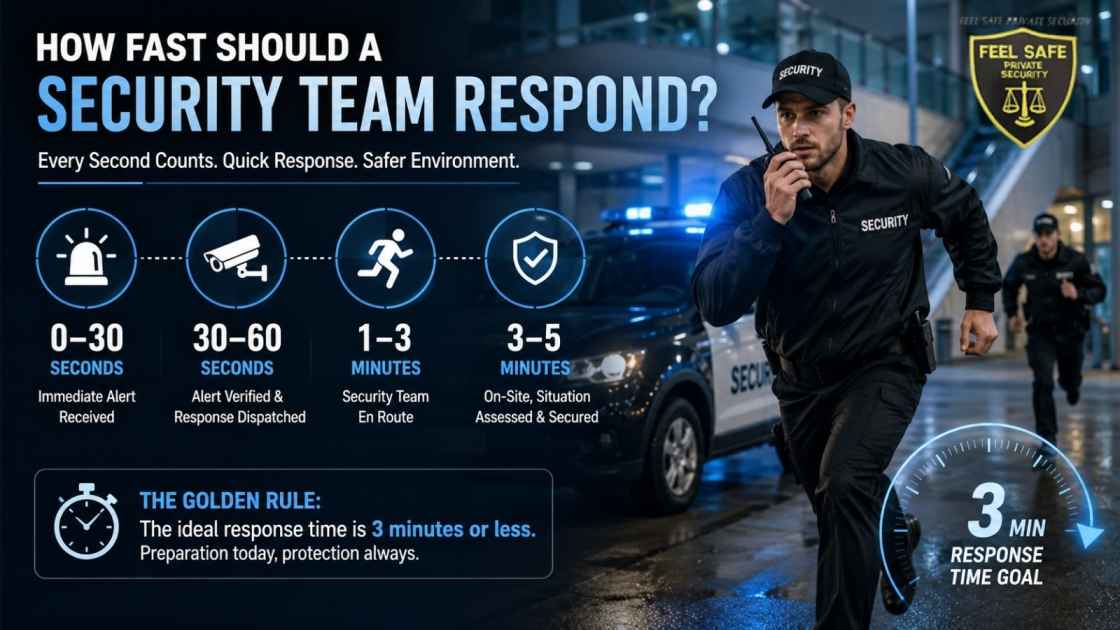
How Fast Should a Security Team Respond? A Guide to Rapid Response Security Services in California
Post Date: August 14, 2026, Post By: Admin
When a security alarm activates at 2 a.m., a gate is found open after hours, or someone reports suspicious activity at a commercial property, every minute matters. But how fast should a security team actually respond?
The answer is more complicated than simply choosing the company that promises the fastest arrival. Effective security depends on the type of incident, property location, available information, access conditions, patrol coverage, communication procedures, and the security provider’s ability to deploy the right resources.
For California businesses and property managers, understanding these factors is essential when evaluating rapid response security services in California.
A strong response program is not just about putting a vehicle on the road quickly. It is about receiving an alert, assessing the situation, dispatching an appropriate security professional, arriving safely, evaluating conditions, documenting what happened, and taking appropriate action within the limits of the law.
This guide explains what response times mean, what affects them, how mobile patrols support faster intervention, and what businesses should ask before selecting a security provider.
Why Security Response Time Matters
Security incidents rarely occur at convenient times.
A suspicious person may enter a property after employees have gone home. A construction site may experience unauthorized access overnight. A retail business may receive an alarm notification during a weekend closure. A vacant building may attract trespassers or vandals when there is nobody on site to notice what is happening.
In each situation, delayed awareness can allow a relatively small problem to become more serious.
Consider a simple example.
A property manager receives an alarm notification indicating that a rear door has opened. There may be an innocent explanation, such as an employee forgetting to secure the door. However, there could also be unauthorized entry.
A well-organized response process should quickly determine:
- What triggered the alert?
- Where did it occur?
- Is anyone authorized to be there?
- Is there information suggesting an immediate threat?
- What response resource is appropriate?
- Who needs to be notified?
- What should happen after the security officer arrives?
This illustrates an important principle: fast response begins before the vehicle moves.
Good preparation, communication, dispatch procedures, and local coverage can make a major difference.
What Does a Rapid Security Response Actually Mean?
The phrase “rapid response” can mean different things to different security companies.
A provider might use it to describe:
- Alarm response
- Mobile patrol dispatch
- After-hours property checks
- Emergency security dispatch
- Lock and unlock services
- Suspicious-activity investigations
- Perimeter checks
- Response to unauthorized access
- Incident verification
- Security support following property damage
Because the term is broad, businesses should ask providers to explain exactly what their response model includes.
A meaningful response-time discussion should distinguish between dispatch time, travel time, and on-site arrival time.
For example:
Alert received → Dispatch decision → Officer dispatched → Travel → Arrival → Site assessment → Appropriate action
A company that communicates clearly throughout this process is easier to evaluate than one that simply advertises an impressive response-time claim without explaining the conditions behind it.
How Fast Should a Security Response Team Arrive?
There is no universal response time that is appropriate for every property or every incident.
An alarm at a commercial building in a densely populated area may be handled differently from an incident at a remote industrial property.
Similarly, an urgent threat involving people requires a different response strategy from a routine after-hours property check.
Businesses should therefore avoid choosing a provider solely on the basis of a single advertised number.
Instead, ask:
What is the target response time?
The provider should be able to explain its typical or target response process.
Under what conditions does that target apply?
Traffic, weather, distance, road closures, simultaneous incidents, and officer availability can all affect travel.
How is an incident prioritized?
A suspected break-in, medical emergency, fire, or violent threat should not necessarily be handled in the same way as a routine access issue.
What happens when the nearest officer is unavailable?
A mature security operation should have procedures for dispatching alternative resources.
The goal is not merely to promise speed. The goal is to establish a reliable, realistic, and clearly communicated response system.
Understanding Security Response Priorities
Effective security response starts with risk assessment.
Not every security event has the same urgency.
A useful framework is to classify incidents according to factors such as:
- Threat to human life
- Active criminal activity
- Evidence of forced entry
- Property damage
- Suspicious activity
- Unauthorized access
- Alarm activation without confirmed threat
- Routine security concerns
If there is an immediate threat to life or serious criminal activity, emergency services may need to be contacted immediately. Private security personnel should not be viewed as a substitute for police, fire, or emergency medical services.
Private security can play an important supporting role by observing conditions, protecting property, controlling access where legally appropriate, communicating information, and following established escalation procedures.
This distinction is particularly important when developing an emergency security plan.
The Role of an Emergency Security Response Team in California
An emergency security response team California businesses rely on should have clearly defined procedures for handling urgent situations.
The response process may include:
- Receiving the call or alarm.
- Gathering available information.
- Determining the incident priority.
- Dispatching the appropriate resource.
- Communicating relevant information to the responding officer.
- Arriving and conducting an initial assessment.
- Contacting emergency services when appropriate.
- Securing or monitoring the affected area.
- Notifying authorized contacts.
- Documenting the incident.
The exact process will vary according to the provider, property, incident type, and applicable laws.
The most important consideration is that the team knows what to do when something goes wrong.
Rapid Deployment Security: Why Local Coverage Matters
Rapid deployment security depends heavily on geography.
A security officer cannot arrive quickly if the nearest available resource is located far away.
This is why businesses should consider where their security provider actually operates and how its patrol network is structured.
A provider serving multiple California communities may use strategically positioned mobile units to improve coverage. The effectiveness of that approach depends on staffing, scheduling, territory, traffic conditions, and the number of properties being serviced.
For property owners, useful questions include:
- Where are patrol units positioned?
- Is there coverage during the hours when the property is most vulnerable?
- How are multiple simultaneous calls prioritized?
- What happens if an officer is already handling another incident?
- How is dispatch information communicated?
- Is there a documented escalation procedure?
These questions reveal considerably more about response capability than marketing language alone.
How Mobile Patrol Supports Faster Response
A mobile patrol model can be particularly useful for properties that do not require a permanently stationed guard but still need a visible security presence and response capability.
Mobile patrol officers can conduct scheduled or randomized checks, depending on the service arrangement.
These patrols may help identify:
- Open gates
- Damaged fencing
- Broken windows
- Unauthorized vehicles
- Suspicious persons
- Lighting problems
- Signs of vandalism
- Evidence of attempted entry
- Other unusual property conditions
A patrol vehicle already operating within a defined service area may also be positioned to respond to nearby incidents.
However, mobile patrol should not be treated as a guarantee of immediate arrival. The actual response depends on where the unit is located when the call comes in and what other incidents are occurring.
That is why realistic expectations and transparent communication matter.
Why Mobile Patrol Security California Businesses Use Is More Than a Visible Vehicle
Mobile patrol security California businesses use can serve two purposes: deterrence and response.
Visible patrol activity can make a property less attractive to opportunistic offenders. At the same time, patrol officers can identify developing problems before they become larger incidents.
For example, a routine nighttime patrol might discover that a rear fence has been damaged.
That observation may prevent a future intrusion.
The officer can document the damage, notify the appropriate contact, and recommend corrective action. In this case, security intervention happens before an actual burglary occurs.
This preventive component is one of the most valuable aspects of a well-designed patrol program.
Incident Response Services Should Include More Than Arrival
Fast arrival is important, but what happens afterward matters just as much.
High-quality incident response services should include a structured process for evaluating and documenting incidents.
Depending on the situation, an officer may need to:
- Assess the immediate environment
- Look for signs of unauthorized access
- Establish whether the property is secure
- Preserve relevant observations
- Contact authorized personnel
- Request emergency services when appropriate
- Monitor the location
- Document the incident
- Report follow-up recommendations
The response should always remain within the officer’s legal authority, training, and company procedures.
A fast but poorly managed response can create additional problems. A disciplined response prioritizes safety, communication, documentation, and appropriate escalation.
Factors That Can Affect Response Time in California
Several practical factors can influence how quickly a security officer reaches a property.
Location
Urban, suburban, and rural properties can have very different travel conditions.
Traffic
California traffic can change substantially depending on the time of day, road construction, collisions, and local conditions.
Distance
The physical distance between an available patrol unit and the property naturally affects arrival time.
Incident volume
If several properties experience incidents at the same time, dispatch resources may need to be prioritized.
Weather and road conditions
Heavy rain, flooding, reduced visibility, or other hazardous conditions can affect safe travel.
Property access
Large campuses, gated communities, industrial facilities, and multi-building sites can make locating the exact incident area more complicated.
Information quality
A vague report such as “something looks wrong” may require additional clarification. Precise information about the building, entrance, alarm zone, or observed activity can help the response team act more efficiently.
Practical Ways Businesses Can Improve Security Response
Businesses do not have to leave the entire burden of response planning to their security provider.
Property owners and managers can improve response effectiveness by preparing their sites.
Maintain accurate emergency contacts
Security providers should know who is authorized to receive notifications and who can make decisions regarding the property.
Keep access information current
Outdated gate codes, keys, access cards, or entry instructions can create unnecessary delays.
Identify vulnerable areas
Document locations such as:
- Rear entrances
- Loading areas
- Parking structures
- Rooftops
- Storage areas
- Construction zones
- Exterior gates
Improve lighting
Adequate lighting can make suspicious activity easier to identify and can improve officer visibility during nighttime inspections.
Keep cameras operational
Security cameras can provide valuable information before and during a response.
Update the response plan
Properties change. New tenants, construction projects, access points, and operating hours can make an old security plan obsolete.
Review procedures periodically.
Common Mistakes Businesses Make
Choosing a provider based only on advertised response time
A response-time promise without context is difficult to evaluate.
Ask how the number is measured and what circumstances can affect it.
Assuming private security replaces emergency services
Security officers can provide valuable assistance, but they are not a substitute for police, fire, or emergency medical response.
Emergency services should be contacted when the circumstances require them.
Failing to update contact information
A response can become unnecessarily complicated if the provider cannot reach the appropriate property representative.
Ignoring preventive patrols
Security should not always begin after an incident occurs.
Routine patrols, inspections, lighting improvements, access control, and camera systems can reduce vulnerabilities before an incident develops.
Focusing only on speed
A rapid but disorganized response is not necessarily effective.
Businesses should evaluate the entire process from alert through documentation and follow-up.
Where Professional Cleaning Fits Into Property Security
At first glance, Professional Cleaning may appear unrelated to security response. In practice, property maintenance and security can overlap in useful ways.
A clean, well-maintained property is often easier to inspect.
For example, neglected areas, accumulated debris, damaged exterior spaces, poor lighting, or blocked access routes can make it harder for security personnel to identify unusual conditions.
Routine maintenance can also help reveal changes.
A broken window, damaged door, graffiti, or displaced equipment is easier to notice when the property is consistently maintained.
This does not mean cleaning prevents crime by itself. Rather, it demonstrates a broader principle of property management: visibility, maintenance, access control, lighting, surveillance, and security response work best as complementary measures.
How to Evaluate a Security Provider Before Signing a Contract
Before hiring a provider for rapid response security services in California, ask for specific answers rather than broad promises.
Ask about coverage
Find out when patrol resources operate in your area and whether service is available during your highest-risk periods.
Ask about dispatch
Understand how calls and alarms are received, prioritized, and assigned.
Ask about communication
Determine how quickly authorized contacts are notified and what information they receive.
Ask about documentation
Incident reports should provide useful information about what occurred, when it occurred, what the officer observed, and what action was taken.
Ask about escalation
Find out how the provider handles situations requiring police, fire, medical assistance, or other emergency resources.
Ask about contingency planning
A strong provider should have procedures for situations involving simultaneous incidents, unavailable personnel, severe weather, or unusual circumstances.
Expert Advice: Think in Terms of Risk, Not Just Minutes
One of the most useful lessons for property managers is to stop thinking about security response as a race.
The objective is not simply to get someone through the gate as quickly as possible.
The objective is to reduce the likelihood and impact of an incident while protecting people and property.
That means asking broader questions:
Can suspicious activity be detected earlier?
Can vulnerabilities be reduced before an incident occurs?
Can the responding officer quickly locate the affected area?
Are emergency contacts reachable?
Are escalation procedures understood?
Is there enough information to make an informed response decision?
These questions create a more resilient security strategy.
For example, a business might combine access control, functioning cameras, adequate lighting, scheduled mobile patrols, clear emergency contacts, and a defined response procedure.
If an alarm then activates, the security team is not starting from zero. The organization already has information, procedures, and resources in place.
Conclusion
The right question is not simply, “How fast can a security officer arrive?”
The better question is, “How effectively can the security provider detect, assess, respond to, and manage an incident?”
For businesses, property managers, construction sites, retail locations, and other California properties, rapid response security services in California can be an important part of a broader security strategy.
Effective protection combines realistic response procedures with prevention, mobile patrol coverage, communication, surveillance, access control, property maintenance, and appropriate emergency escalation.
When evaluating an emergency security response team in California businesses can rely on, look beyond headline response times. Examine the complete operating model, ask practical questions, and make sure the provider’s procedures match the actual risks and layout of your property.
Feel Safe Private Security can be considered as part of that evaluation process when businesses are looking for a security partner focused on organized response, patrol coverage, and practical property protection.
Frequently Asked Questions
1. What is considered a rapid security response?
Rapid security response generally refers to a security provider’s ability to receive an incident notification, assess its priority, dispatch an appropriate officer or patrol unit, and respond to the property as efficiently as circumstances allow.
There is no single response time that applies to every California property. Distance, traffic, incident priority, patrol availability, access conditions, and other factors can affect arrival.
When comparing providers, ask for realistic target times and an explanation of how those targets are measured.
2. Are mobile patrols effective for after-hours property security?
Yes, mobile patrols can be useful for properties that need regular visibility and response coverage without requiring a continuously stationed officer.
Patrols can identify problems such as damaged fencing, open gates, suspicious activity, or signs of attempted entry. Their deterrent value can also be useful.
However, mobile patrol is not a guarantee that an officer will always be immediately available. Businesses should understand patrol routes, schedules, coverage areas, and response procedures before relying on the service.
3. When should a business contact emergency services instead of waiting for private security?
If there is an immediate threat to life, serious injury, an active violent crime, fire, or another emergency requiring police, fire, or medical assistance, the appropriate emergency service should be contacted immediately.
Private security can support the response by providing observations, helping manage access where legally appropriate, protecting property, and communicating with authorized parties.
Businesses should establish these escalation rules before an incident occurs rather than attempting to develop them during a crisis.
4. How can a business reduce security response delays?
Start with preparation.
Keep emergency contacts current, provide accurate access instructions, clearly identify buildings and entrances, maintain lighting and surveillance systems, and ensure security providers have updated property information.
Regular mobile patrols can also identify vulnerabilities before they develop into emergencies.
The more accurately a responding officer can understand the property and the incident location, the easier it can be to conduct an organized response.
5. What should I ask a California security company about response times?
Ask how response time is defined, how incidents are prioritized, where patrol resources are located, what happens when the nearest officer is unavailable, how authorized contacts are notified, and how incidents are documented.
Also ask what circumstances can affect arrival times.
A trustworthy provider should be willing to explain these limitations rather than presenting response time as an unconditional guarantee.
Book Your Services
Our Blog
- Why Hospitality Businesses Need Professional Security Guards
- Security Solutions for Hotels and Retail Stores
- What to Expect From Rapid Response Security Services in California
- How Rapid Response Security Teams Handle Emergencies
- Security Challenges in Parking Lots and Retail Centers
- Why Shopping Centers Need Professional Security Guards
- How Fast Should a Security Team Respond? A Guide to Rapid Response Security Services in California
- Event Security Planning Guide for Safe Gatherings
- Benefits of Residential Security Guards for Community Safety
- How to Choose the Best Security Guard Company in California
- Why 24 Hour Security Monitoring Is Important for Businesses
- Why Hospitals and Clinics Need Professional Security Services
- Why Apartment Complexes Need Residential Security Guards
- Hospital Security Services in California
- How Commercial Security Guards in California Protect Business Properties
- Top Security Risks in Commercial Buildings and Offices
- Why Nightclubs Need Professional Security Guards
- The Role of Unarmed Security Guards in Workplace Safety
- Armed vs Unarmed Security Guards: Which One Is Right for Your Business
- When Businesses Should Hire Armed Security Guards
- How to Choose the Best Unarmed Security Guard Company in California
- How to Choose the Best Security Guard Company in California
- Why Banks Need Professional Security Guards
- Why Businesses Hire Professional Security Guard Services in California
- Top Security Risks in Commercial Buildings and Offices
- Benefits of Hiring Licensed Security Officers for Businesses
- Top Reasons Businesses Need Armed Security Guards in California
- Why Hiring Professional Security Officers in California Is Essential for Businesses
- What Makes a Professional Security Guard Company in California Reliable?
- Top Benefits of Hiring Armed Security Guards in California
- How Professional Bank Security Guards Prevent Robbery and Fraud
- Why Rely On Event Security Services for Crowd Control at California Events
- Strengthening Community Protection Through Reliable Home Security in Tracy Approaches
- How a Bank Security Officer in Manteca Protects What Matters Most to You
- Why a Private Security Guard Is Essential for Business and Community Safety
- Safe Home Security Stockton – Trusted Protection for Your Family and Property
- Choosing the Right Security Guard Services in Modesto for Your Needs
- Why Our Security Services Tracy Are the First Choice for Local Protection
- Stay Protected With Our Expert Event Security Guards Manteca for Every Occasion
- Top Security Companies Lodi Trusts for Bank and Guard Protection Services
- Protecting What Matters Most with Security Services Stockton You Can Trust
- Improving The Security Of A Shopping Mall
- What To Ask Before Hiring A Security Officer?
- Duties Of An Enhanced Security Officer