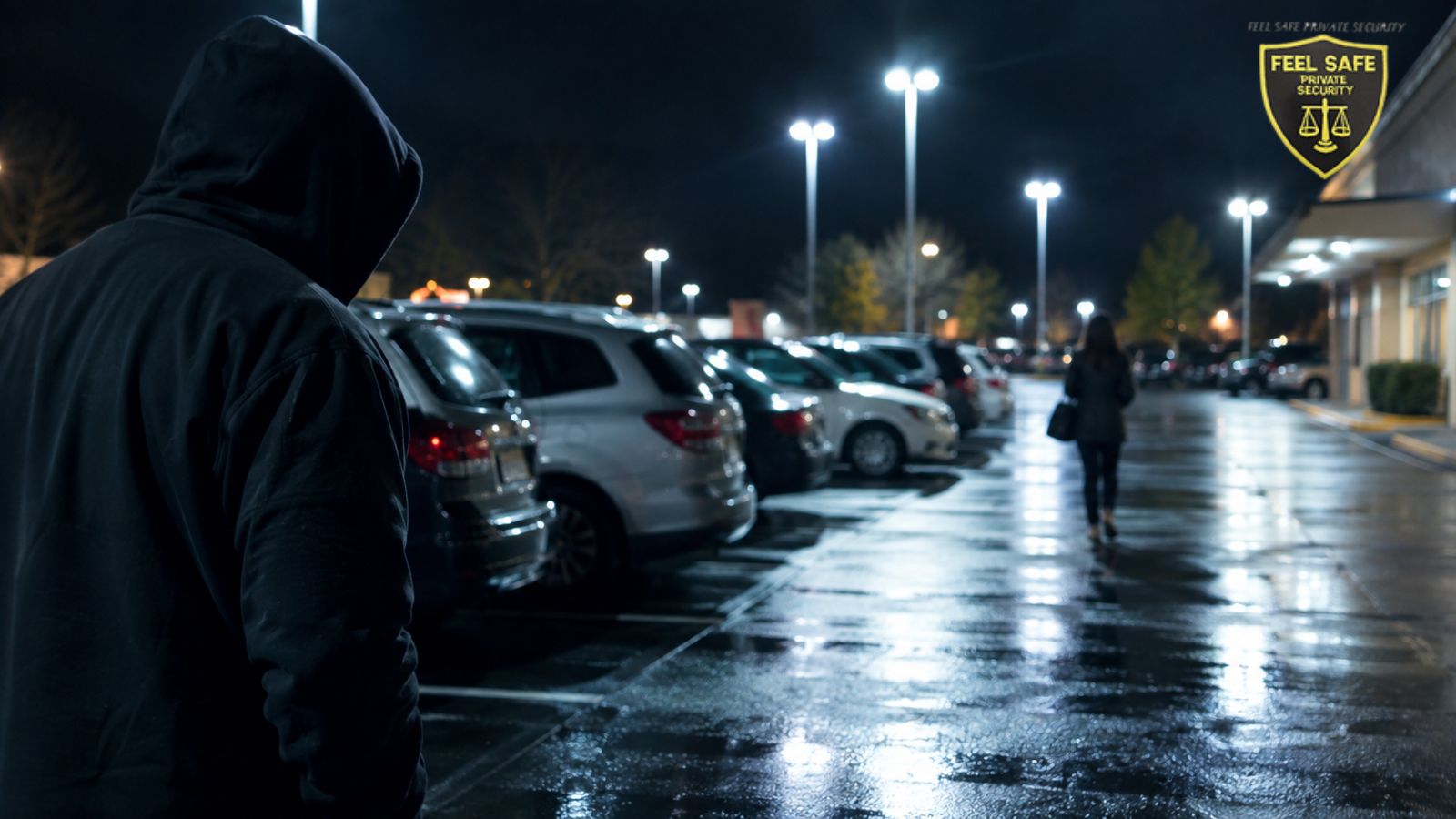
Security Challenges in Parking Lots and Retail Centers
Post Date: August 28, 2026, Post By: Admin
A busy retail centre can feel safe inside the building while serious Security Challenges develop just outside it. Parking areas, loading zones, entrances, pedestrian walkways and shopping centre perimeters can create opportunities for theft, vehicle crime, disorderly behaviour and safety incidents. For property owners and managers, security is therefore about more than responding after something happens. Shopping center security guards in California can provide a visible presence, monitor changing conditions and help teams identify risks before they become more serious. This guide explains the practical challenges retail properties face and the strategies that can make security operations more effective.
Why Retail Centres Face Complex Security Challenges
Retail properties are unusually dynamic environments. Unlike an office building with relatively predictable occupancy, a shopping centre can experience hundreds or thousands of people moving through different areas throughout the day. Customers arrive by car, employees move between buildings, delivery drivers access service areas, and contractors may work outside normal trading hours.
That constant movement creates multiple points where security risks can develop. A person attempting to steal merchandise may use a crowded entrance or exit to avoid attention. A vehicle may remain parked in an isolated area for an unusual length of time. An argument that begins inside a shop may move into a car park, where fewer staff are available to intervene.
Experienced security planning considers these transitions rather than focusing exclusively on the shop floor. Retail security guards California properties use can be particularly valuable when security teams understand how activity changes according to opening hours, peak shopping periods, weather, events and the physical layout of the property.
Shopping Security Requires More Than a Visible Guard
A uniformed guard can act as an important deterrent, but effective shopping security involves much more than simply having someone present. Guards need to know what normal activity looks like so that unusual behaviour becomes easier to recognise.
For example, a person walking through a car park carrying shopping bags is normal. Someone repeatedly checking vehicle doors, moving between rows without entering a business, or appearing to test unattended property presents a different pattern. Security personnel should observe behaviour objectively, document relevant incidents and respond according to established procedures rather than making assumptions based on appearance.
This distinction is important because good security protects both the property and the people using it. Professional observation should be based on conduct and circumstances, not stereotypes.
Retail Security and Retail Theft Prevention Security
Retail theft remains a major concern for many shopping centres, but effective retail theft prevention security should not be reduced to watching customers suspiciously. Theft prevention works best when physical security, employee awareness, surveillance systems, access control and trained personnel operate together.
A practical security programme begins by identifying where incidents actually occur. Managers can review incident reports, camera footage, employee observations and loss patterns to determine whether problems are concentrated near particular entrances, exits, high-value merchandise areas or specific trading periods.
How Guards Support Retail Theft Prevention
Security personnel can contribute by maintaining a visible presence around vulnerable areas, conducting scheduled patrols and communicating relevant observations to authorised staff. Their presence can also help employees feel supported when dealing with suspicious situations.
Consider a retail centre where several businesses have experienced repeated shoplifting incidents during late afternoon trading. Instead of randomly increasing patrols, management could examine the pattern and position security personnel around relevant entrances, pedestrian routes and parking transitions during that period.
The goal is not to treat every customer as a potential offender. It is to create an environment where suspicious activity is more likely to be noticed and appropriate action can be taken quickly.
Why Communication Matters
Security officers often become an important communication link between retailers, property management and emergency responders. Clear reporting can help identify repeat patterns that may otherwise appear as isolated incidents.
An incident report should be factual and useful. It can record the time, location, observable behaviour, people involved, actions taken and relevant witnesses or evidence, where appropriate. Consistent documentation helps management identify trends and evaluate whether security measures are actually working.
Mall Security and Customer Safety Security
Mall security guards California properties employ may have responsibilities extending well beyond theft prevention. Customer safety can involve medical emergencies, lost children, disputes, hazards, suspicious packages, access issues, accidents and situations involving distressed individuals.
Customer Safety Security Starts With Awareness
Customer safety security depends heavily on situational awareness. Guards need to understand the property’s normal patterns and know where vulnerable areas are located. Entrances, escalators, food courts, playgrounds, event spaces and pedestrian crossings can each create different operational concerns.
For example, during a major promotional event, a shopping centre may experience unusually high pedestrian traffic near one entrance. The security plan may need to change temporarily to manage crowd movement, maintain emergency access and reduce conflicts between vehicles and pedestrians.
This is where experience matters. A security plan that works on a quiet Tuesday morning may be inadequate during a weekend sale or holiday shopping period.
Responding to Difficult Situations
Security personnel should also understand the difference between observation, intervention and escalation. Not every dispute requires the same response. A minor disagreement may be resolved through calm communication, while a serious threat may require immediate assistance from emergency services.
The objective should always be a proportionate and lawful response. Security guards are not a replacement for police, fire or medical services. Their role is generally to observe, deter, communicate, protect people and property within their authorised responsibilities, and obtain appropriate assistance when a situation exceeds those responsibilities.
Parking Lot Security and Parking Area Monitoring
Parking areas can present some of the most difficult Security Challenges because they are large, open and often separated from staffed retail spaces. Visibility can vary significantly between rows, lighting conditions may change after sunset, and vehicles create numerous concealed areas.
Parking lot security guards California properties use can help address these vulnerabilities through mobile patrols, fixed-position observation and targeted monitoring of higher-risk areas.
Parking Area Monitoring in Practice
Effective parking area monitoring is not necessarily about continuously walking every section of a car park. Patrol frequency and routes can be designed around actual risk.
Security teams may pay particular attention to:
- Poorly lit sections
- Remote parking rows
- Vehicle and pedestrian entrances
- Payment or ticketing areas
- Loading and service zones
- Areas near public transport connections
- Locations with a history of incidents
A guard may notice a vehicle that has remained stationary for an unusual period, observe an apparent vehicle break-in attempt or identify a hazard such as damaged lighting. These observations can be documented and escalated appropriately.
Vehicle Crime Requires a Practical Approach
Vehicle-related incidents can involve theft from vehicles, vehicle damage, unauthorised access and disputes over parking spaces. Guards cannot guarantee that a crime will never occur, but a visible and active security presence can make some opportunistic activity more difficult.
Clear signage, functioning lighting, working CCTV, well-maintained landscaping and predictable patrols can complement personnel. Security should therefore be viewed as a system rather than a single measure.
Retail Property Protection Across the Entire Site
Retail property protection should extend beyond individual shops. A shopping centre may include common areas, service corridors, storage zones, rooftop access points, plant areas, delivery docks and external equipment.
These areas can be overlooked because customers rarely interact with them. However, unauthorised access to restricted locations can create operational and safety risks.
Identifying Vulnerable Property
Property managers should conduct periodic security assessments that consider both obvious and overlooked assets. Questions can include:
- Which doors or gates are frequently left unsecured?
- Are service areas adequately monitored?
- Can unauthorised vehicles reach restricted zones?
- Are external lights working consistently?
- Are cameras positioned to cover important approaches?
- Do employees know how to report suspicious activity?
- Are patrol routes based on current risks?
A practical assessment should also consider how the site changes after dark. A location that appears highly visible during daylight can have very different security characteristics at night.
Security Challenges During Opening, Closing and After Hours
Opening and closing periods can create specific vulnerabilities because employee activity changes rapidly. Staff may be entering or leaving with keys, cash, equipment or other property while customers are arriving or departing.
After-hours conditions can be particularly different. Empty walkways, closed storefronts and reduced pedestrian traffic can make unusual activity easier to identify, but they can also leave fewer people available to notice problems.
A well-designed security operation accounts for these transition periods rather than applying the same patrol schedule throughout the day. Guards can coordinate with authorised property personnel, observe access points and report unusual conditions while remaining within their defined responsibilities.
Common Mistakes in Retail Centre Security
One common mistake is assuming that CCTV alone provides sufficient protection. Cameras are valuable for deterrence, monitoring and investigation, but they cannot physically observe every location or respond to developing incidents.
Another mistake is using identical patrol patterns every day. Predictability can reduce the effectiveness of patrols because potential offenders may learn when particular areas are unattended. Patrol strategies should instead reflect risk assessments and operational requirements.
A third mistake is failing to review security after an incident. An event should not simply be documented and forgotten. Management can ask what happened, where it happened, whether existing controls worked and whether environmental or procedural changes could reduce the likelihood of recurrence.
Expert Tips for Stronger Retail Property Security
Experienced security planning tends to focus on prevention, consistency and communication. Property managers should begin by identifying their highest-risk locations rather than attempting to treat every area identically.
Build Security Around Real Activity
Security measures should reflect actual site conditions. Analyse incident reports, busy periods, delivery schedules, tenant concerns and parking patterns. This produces a more useful security plan than relying on assumptions.
Keep Reporting Consistent
Every relevant incident should be documented according to the property’s procedures. Consistent reports help identify recurring locations, times and behaviours and provide management with information for future decisions.
Combine People and Technology
Guards, CCTV, lighting, alarms, access controls and signage can work together. Technology can provide information, while trained personnel can interpret observations, communicate with stakeholders and respond within their authorised role.
Review the Plan Regularly
Retail environments change. New tenants, construction, seasonal shopping, events and changes to parking arrangements can introduce new risks. Security plans should therefore be reviewed whenever the property’s operational conditions change significantly.
Choosing a Security Approach for California Retail Properties
There is no universal security model for every shopping centre. A small neighbourhood retail property may require a different approach from a large multi-building complex with extensive parking and multiple access points. The right strategy should be based on the site’s layout, operating hours, incident history, tenant requirements and identified risks.
Property managers considering retail property security services California businesses provide should look beyond the number of guards offered. They should evaluate training, communication procedures, reporting standards, supervision, experience with comparable properties and the provider’s ability to adapt its approach to changing conditions.
The same principle applies when considering mall security guards California or parking lot security guards California. Security effectiveness depends on how personnel are deployed and managed, not simply on having a uniformed presence somewhere on the property.
Conclusion:
The most effective approach to retail security is proactive rather than reactive. Security Challenges in parking lots and retail centres can involve theft, vehicle crime, unauthorised access, customer safety concerns and changing risks throughout the day. Addressing them requires more than simply placing a guard at an entrance. Property layout, patrol strategy, surveillance, lighting, reporting, communication and emergency escalation all have a role.
For property managers seeking shopping center security guards in California, Feel Safe Private Security can be considered as part of a broader site-specific security strategy. The priority should remain understanding the property’s risks, establishing practical procedures and ensuring security personnel are equipped to respond appropriately.
Feel Safe Private Security takes a practical approach to retail environments by focusing on visibility, awareness, reporting and responsible response. Whether the concern involves retail premises, shared shopping areas or parking facilities, a carefully planned security operation can help create a more controlled environment while supporting retail property protection and customer confidence.
Frequently Asked Questions
1. What are the biggest security challenges in retail centre parking lots?
Common concerns include vehicle-related crime, theft from vehicles, vandalism, suspicious activity, pedestrian-vehicle conflicts and incidents occurring in areas with limited visibility. The level of risk varies according to location, lighting, property design, operating hours and previous incidents. Effective parking security combines patrols, lighting, CCTV, environmental design, incident reporting and appropriate response procedures rather than relying on one control.
2. Can security guards prevent retail theft?
No security provider can guarantee that theft will never occur. However, trained security personnel can contribute to deterrence through visibility, observation and timely reporting. They can also help retailers recognise recurring patterns and strengthen vulnerable areas. The strongest retail theft prevention security strategy combines trained personnel with store procedures, surveillance technology, employee awareness and appropriate physical security measures.
3. What is the role of security guards during a customer safety incident?
The role depends on the circumstances and the guard’s authorised responsibilities. Security personnel may provide an initial response, protect the area, communicate with property management and contact emergency services when appropriate. Guards should not attempt to perform duties beyond their training or legal authority. Clear escalation procedures help ensure that serious medical, fire, criminal or public-safety incidents reach the appropriate emergency service quickly.
4. How can a shopping centre improve parking area monitoring?
Start by identifying poorly lit locations, isolated parking sections, access points and areas with previous incidents. Review CCTV coverage, lighting, landscaping and patrol patterns, then adjust monitoring around actual risk periods. Parking area monitoring can also be improved through consistent reporting, communication with retailers and regular reviews of incidents. The objective is to make the environment less attractive to opportunistic offending while improving visibility and response.
5. Why is professional security planning important for shopping centres?
Shopping centres contain multiple businesses, public areas, vehicles, employees and service zones, so security requirements can change considerably across the same property. A structured security plan helps identify vulnerabilities and determine where personnel, technology and procedures can provide the greatest benefit. For shopping center security guards in California, understanding the property’s specific risks is particularly important because effective security should be adapted to the site’s environment rather than delivered as a one-size-fits-all service.
Book Your Services
Our Blog
- Why Hospitality Businesses Need Professional Security Guards
- Security Solutions for Hotels and Retail Stores
- What to Expect From Rapid Response Security Services in California
- How Rapid Response Security Teams Handle Emergencies
- Security Challenges in Parking Lots and Retail Centers
- Why Shopping Centers Need Professional Security Guards
- How Fast Should a Security Team Respond? A Guide to Rapid Response Security Services in California
- Event Security Planning Guide for Safe Gatherings
- Benefits of Residential Security Guards for Community Safety
- How to Choose the Best Security Guard Company in California
- Why 24 Hour Security Monitoring Is Important for Businesses
- Why Hospitals and Clinics Need Professional Security Services
- Why Apartment Complexes Need Residential Security Guards
- Hospital Security Services in California
- How Commercial Security Guards in California Protect Business Properties
- Top Security Risks in Commercial Buildings and Offices
- Why Nightclubs Need Professional Security Guards
- The Role of Unarmed Security Guards in Workplace Safety
- Armed vs Unarmed Security Guards: Which One Is Right for Your Business
- When Businesses Should Hire Armed Security Guards
- How to Choose the Best Unarmed Security Guard Company in California
- How to Choose the Best Security Guard Company in California
- Why Banks Need Professional Security Guards
- Why Businesses Hire Professional Security Guard Services in California
- Top Security Risks in Commercial Buildings and Offices
- Benefits of Hiring Licensed Security Officers for Businesses
- Top Reasons Businesses Need Armed Security Guards in California
- Why Hiring Professional Security Officers in California Is Essential for Businesses
- What Makes a Professional Security Guard Company in California Reliable?
- Top Benefits of Hiring Armed Security Guards in California
- How Professional Bank Security Guards Prevent Robbery and Fraud
- Why Rely On Event Security Services for Crowd Control at California Events
- Strengthening Community Protection Through Reliable Home Security in Tracy Approaches
- How a Bank Security Officer in Manteca Protects What Matters Most to You
- Why a Private Security Guard Is Essential for Business and Community Safety
- Safe Home Security Stockton – Trusted Protection for Your Family and Property
- Choosing the Right Security Guard Services in Modesto for Your Needs
- Why Our Security Services Tracy Are the First Choice for Local Protection
- Stay Protected With Our Expert Event Security Guards Manteca for Every Occasion
- Top Security Companies Lodi Trusts for Bank and Guard Protection Services
- Protecting What Matters Most with Security Services Stockton You Can Trust
- Improving The Security Of A Shopping Mall
- What To Ask Before Hiring A Security Officer?
- Duties Of An Enhanced Security Officer